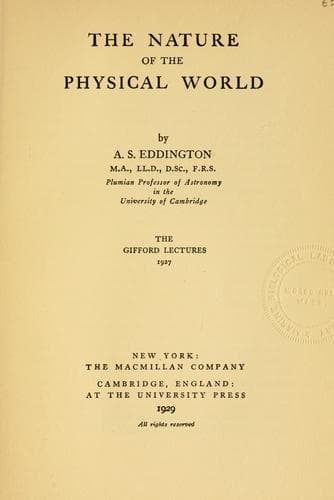
The nature of the physical worldEddington, Arthur Stanley, Sir
Philosophy
The nature of the physical world
Eddington, Arthur Stanley, Sir
Physics -- Philosophy; Science -- Philosophy
the word as a kind of halo of indefinite import. We have seen that the
trend of modern physics is to reject these indefinite attributions
and to define its terms according to the way in which we recognise
the properties when confronted by them. We recognise the actuality
of a particular world because it is that world alone with which
consciousness interacts. However much the theoretical physicist may
dislike a reference to consciousness, the experimental physicist uses
freely this touchstone of actuality. He would perhaps prefer to believe
that his instruments and observations are certified as actual by his
material sense organs; but the final guarantor is the mind that comes
to know the indications of the material organs. Each of us is armed
with this touchstone of actuality; by applying it we decide that this
sorry world of ours is actual and Utopia is a dream. As our individual
consciousnesses are different, so our touchstones are different; but
fortunately they all agree in their indication of actuality—or at any
rate those which agree are in sufficient majority to shut the others up
in lunatic asylums.
It is natural that theoretical physics in its formulation of a general
scheme of law should leave out of account actuality and the guarantor
of actuality. For it is just this omission which makes the difference
between a law of Nature and a particular sequence of events. That which
is possible (or not “too improbable”) is the domain of natural science;
that which is actual is the domain of natural history. We need scarcely
add that the contemplation in natural science of a wider domain than
[Pg 267]
the actual leads to a far better understanding of the actual.
From a broader point of view than that of elaborating the physical
scheme of law we cannot treat the connection with mind as merely
an incident in a self-existent inorganic world. In saying that the
differentiation of the actual from the non-actual is only expressible
by reference to mind I do not mean to imply that a universe without
conscious mind would have no more status than Utopia. But its
property of actuality would be indefinable since the one approach to
a definition is cut off. The actuality of Nature is like the beauty
of Nature. We can scarcely describe the beauty of a landscape as
non-existent when there is no conscious being to witness it; but it
is through consciousness that we can attribute a meaning to it. And
so it is with the actuality of the world. If actuality means “known
to mind” then it is a purely subjective character of the world; to
make it objective we must substitute “knowable to mind”. The less
stress we lay on the accident of parts of the world being known at
the present era to particular minds, the more stress we must lay
on the potentiality of being known to mind as a fundamental
objective property of matter, giving it the status of actuality whether
individual consciousness is taking note of it or not.
Public-domain text, read in full here on John Shaqi.
Reviews
Reviews
No reviews yet
Be the first to share your thoughts on this work.
Elsewhere in the archive
Join the Discussion
Join the discussion
Sign in to leave a comment or review.
Sign InorCreate an account