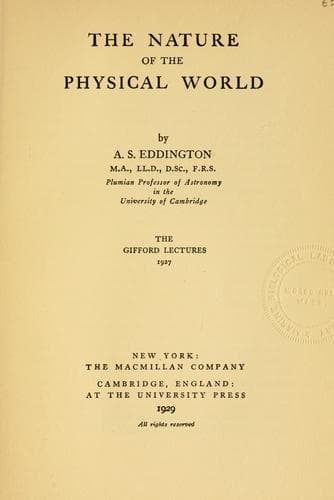
The nature of the physical worldEddington, Arthur Stanley, Sir
Philosophy
The nature of the physical world
Eddington, Arthur Stanley, Sir
Physics -- Philosophy; Science -- Philosophy
But I am not now writing of pure physics, and from a broader standpoint
I do not see how we can leave out Mr. X. The fact that matter is
“knowable to Mr. X” must be set down as one of the fundamental
attributes of matter. I do not say that it is very distinctive,
since other entities of physics are also knowable to him; but the
potentiality of the whole physical world for awaking impressions in
consciousness is an attribute not to be ignored when we compare the
actual world with worlds which, we fancy, might have been
created. There seems to be a prevalent disposition to minimise the
importance of this. The attitude is that “knowableness to Mr. X” is a
negligible attribute, because Mr. X is so clever that he could know
pretty much anything that there was to know. I have already urged the
contrary view—that there is a definitely selective action of the
mind; and since physics treats of what is knowable to mind[43] its
[Pg 265]
subject-matter has undergone, and indeed retains evidences of, this
process of selection.
Actuality. “Knowableness to mind” is moreover a property which
differentiates the actual world of our experience from imaginary worlds
in which the same general laws of Nature are supposed to hold true.
Consider a world—Utopia, let us say—governed by all the laws of
Nature known and unknown which govern our own world, but containing
better stars, planets, cities, animals, etc.—a world which might
exist, but it just happens that it doesn’t. How can the physicist test
that Utopia is not the actual world? We refer to a piece of matter in
it; it is not real matter but it attracts any other piece of (unreal)
matter in Utopia according to the law of gravitation. Scales and clocks
constructed of this unreal matter will measure wrong intervals, but
the physicist cannot detect that they are wrong unless he has first
shown the unreality of the matter. As soon as any element in it has
been shown to be unreal Utopia collapses; but so long as we keep to
the cycles of physics we can never find the vulnerable point, for each
element is correctly linked to the rest of the cycle, all our laws of
Nature expressed by the cycle being obeyed in Utopia by hypothesis.
The unreal stars emit unreal light which falls on unreal retinas and
ultimately reaches unreal brains. The next step takes it outside the
cycle and gives the opportunity of exposing "the whole deception.
Is the brain disturbance translated into consciousness? That will
test whether the brain is real or unreal. There is no question about
consciousness being real or not; consciousness is self-knowing and the
epithet real adds nothing to that. Of the infinite number of worlds
which are examples of what might be possible under the laws of Nature,
[Pg 266]
there is one which does something more than fulfil those laws of
Nature. This property, which is evidently not definable with respect to
any of the laws of Nature, we describe as “actuality”—generally using
Public-domain text, read in full here on John Shaqi.
Reviews
Reviews
No reviews yet
Be the first to share your thoughts on this work.
Elsewhere in the archive
Join the Discussion
Join the discussion
Sign in to leave a comment or review.
Sign InorCreate an account