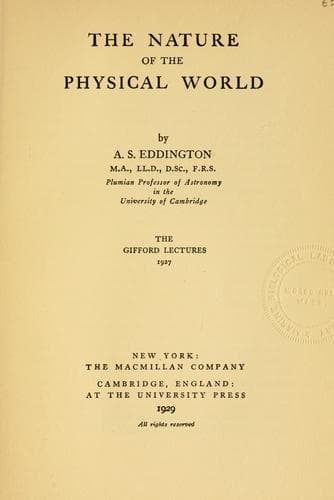
The nature of the physical worldEddington, Arthur Stanley, Sir
Philosophy
The nature of the physical world
Eddington, Arthur Stanley, Sir
Physics -- Philosophy; Science -- Philosophy
physical system of inference, but to that insight beneath the symbols
which in our own minds we possess. It is by this insight that we can
finally reach an answer to our question, What is Mr. X?
[41]
A good illustration of such substitution is afforded by
astronomical observations of a certain double star with two components
of equal brightness. After an intermission of observation the two
components were inadvertently interchanged, and the substitution was
not detected until the increasing discrepancy between the actual and
predicted orbits was inquired into.
[42]
For example, we should most of us assume (hypothetically)
that the dynamical quality of the world referred to in chapter V
is characteristic of the whole background. Apparently it is
not to be found in the pointer readings, and our only insight into
it is in the feeling of “becoming” in our consciousness. “Becoming”
like “reasoning” is known to us only through its occurrence in our
own minds; but whereas it would be absurd to suppose that the latter
extends to inorganic aggregations of atoms, the former may be (and
commonly is) extended to the inorganic world, so that it is not a
matter of indifference whether the progress of the inorganic world is
viewed from past to future or from future to past.
[43]
This is obviously true of all experimental physics, and
must be true of theoretical physics if it is (as it professes to be)
based on experiment.
[44]
The solitary exception is, I believe, Dirac’s
generalisation which introduces -numbers (p. 210). There is as yet
no approach to a general system of inference on a non-numerical basis.
[Pg 273]
Chapter XIII
REALITY
The Real and the Concrete. One of our ancestors, taking arboreal
exercise in the forest, failed to reach the bough intended and his hand
closed on nothingness. The accident might well occasion philosophical
reflections on the distinctions of substance and void—to say nothing
of the phenomenon of gravity. However that may be, his descendants
down to this day have come to be endowed with an immense respect for
substance arising we know not how or why. So far as familiar experience
is concerned, substance occupies the centre of the stage, rigged out
with the attributes of form, colour, hardness, etc., which appeal to
our several senses. Behind it is a subordinate background of space and
time permeated by forces and unconcrete agencies to minister to the
star performer.
Public-domain text, read in full here on John Shaqi.
Reviews
Reviews
No reviews yet
Be the first to share your thoughts on this work.
Elsewhere in the archive
Join the Discussion
Join the discussion
Sign in to leave a comment or review.
Sign InorCreate an account