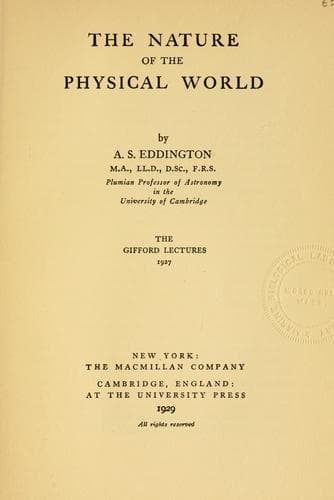
The nature of the physical worldEddington, Arthur Stanley, Sir
Philosophy
The nature of the physical world
Eddington, Arthur Stanley, Sir
Physics -- Philosophy; Science -- Philosophy
What the physiologist sees when he examines a brain is in the
physiologist, not in the brain he is examining. What is in the brain
by the time the physiologist examines it if it is dead, I do not
profess to know; but while its owner was alive, part, at least,
of the contents of his brain consisted of his percepts, thoughts,
and feelings. Since his brain also consisted of electrons, we are
compelled to conclude that an electron is a grouping of events, and
[Pg 279]
that if the electron is in a human brain, some of the events composing
it are likely to be some of the “mental states” of the man to whom
the brain belongs. Or, at any rate, they are likely to be parts of
such “mental states”—for it must not be assumed that part of a mental
state must be a mental state. I do not wish to discuss what is meant
by a “mental state”; the main point for us is that the term must
include percepts. Thus a percept is an event or a group of events,
each of which belongs to one or more of the groups constituting the
electrons in the brain. This, I think, is the most concrete statement
that can be made about electrons; everything else that can be said is
more or less abstract and mathematical.
I quote this partly for the sake of the remark that it must not be
assumed that part of a mental state must necessarily be a mental state.
We can no doubt analyse the content of consciousness during a short
interval of time into more or less elementary constituent feelings; but
it is not suggested that this psychological analysis will reveal the
elements out of whose measure-numbers the atoms or electrons are built.
The brain-matter is a partial aspect of the whole mental state; but the
analysis of the brain-matter by physical investigation does not run at
all parallel with the analysis of the mental state by psychological
investigation. I assume that Russell meant to warn us that, in speaking
of part of a mental state, he was not limiting himself to parts that
would be recognised as such psychologically, and he was admitting a
more abstract kind of dissection.
This might give rise to some difficulty if we were postulating complete
identity of mind-stuff with consciousness. But we know that in the mind
there are memories not in consciousness at the moment but capable of
being summoned into consciousness. We are vaguely aware that things
we cannot recall are lying somewhere about and may come into the
mind at any moment. Consciousness is not sharply defined, but fades
[Pg 280]
into subconsciousness; and beyond that we must postulate something
indefinite but yet continuous with our mental nature. This I take to
be the world-stuff. We liken it to our conscious feelings because,
now that we are convinced of the formal and symbolic character of the
entities of physics, there is nothing else to liken it to.
Public-domain text, read in full here on John Shaqi.
Reviews
Reviews
No reviews yet
Be the first to share your thoughts on this work.
Elsewhere in the archive
Join the Discussion
Join the discussion
Sign in to leave a comment or review.
Sign InorCreate an account