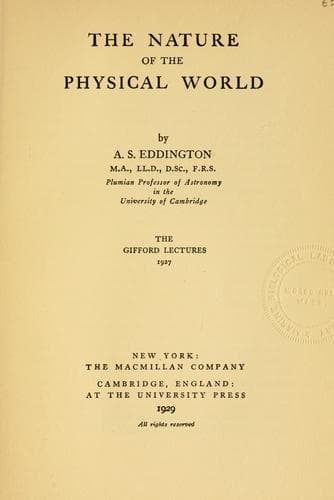
The nature of the physical worldEddington, Arthur Stanley, Sir
Philosophy
The nature of the physical world
Eddington, Arthur Stanley, Sir
Physics -- Philosophy; Science -- Philosophy
The mind-stuff is not spread in space and time; these are part of the
cyclic scheme ultimately derived out of it. But we must presume that in
some other way or aspect it can be differentiated into parts. Only here
and there does it rise to the level of consciousness, but from such
islands proceeds all knowledge. Besides the direct knowledge contained
in each self-knowing unit, there is inferential knowledge. The latter
includes our knowledge of the physical world. It is necessary to
keep reminding ourselves that all knowledge of our environment from
which the world of physics is constructed, has entered in the form of
messages transmitted along the nerves to the seat of consciousness.
Obviously the messages travel in code. When messages relating to a
table are travelling in the nerves, the nerve-disturbance does not
in the least resemble either the external table that originates
the mental impression or the conception of the table that arises
in consciousness.[45] In the central clearing station the incoming
messages are sorted and decoded, partly by instinctive image-building
inherited from the experience of our ancestors, partly by scientific
[Pg 278]
comparison and reasoning. By this very indirect and hypothetical
inference all our supposed acquaintance with and our theories of a
world outside us have been built up. We are acquainted with an external
world because its fibres run into our consciousness; it is only our
own ends of the fibres that we actually know; from those ends we
more or less successfully reconstruct the rest, as a palaeontologist
reconstructs an extinct monster from its footprint.
The mind-stuff is the aggregation of relations and relata which form
the building material for the physical world. Our account of the
building process shows, however, that much that is implied in the
relations is dropped as unserviceable for the required building. Our
view is practically that urged in 1875 by W. K. Clifford—
“The succession of feelings which constitutes a man’s consciousness is
the reality which produces in our minds the perception of the motions
of his brain.”
That is to say, that which the man himself knows as a succession of
feelings is the reality which when probed by the appliances of an
outside investigator affects their readings in such a way that it is
identified as a configuration of brain-matter. Again Bertrand Russell
writes—[46]
Public-domain text, read in full here on John Shaqi.
Reviews
Reviews
No reviews yet
Be the first to share your thoughts on this work.
Elsewhere in the archive
Join the Discussion
Join the discussion
Sign in to leave a comment or review.
Sign InorCreate an account