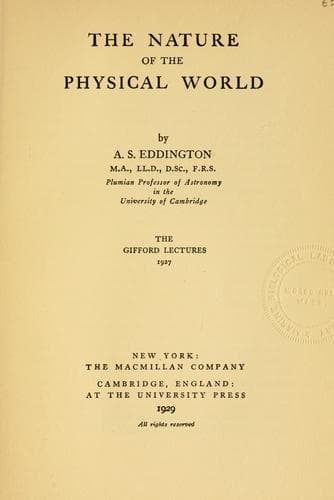
The nature of the physical worldEddington, Arthur Stanley, Sir
Philosophy
The nature of the physical world
Eddington, Arthur Stanley, Sir
Physics -- Philosophy; Science -- Philosophy
The Definition of Reality. It is time we came to grips with the
loose terms Reality and Existence, which we have been using without
any inquiry into what they are meant to convey. I am afraid of this
word Reality, not connoting an ordinarily definable characteristic of
the things it is applied to but used as though it were some kind of
celestial halo. I very much doubt if any one of us has the faintest
idea of what is meant by the reality or existence of anything but
our own Egos. That is a bold statement, which I must guard against
misinterpretation. It is, of course, possible to obtain consistent use
of the word “reality” by adopting a conventional definition. My own
[Pg 283]
practice would probably be covered by the definition that a thing may
be said to be real if it is the goal of a type of inquiry to which I
personally attach importance. But if I insist on no more than this I am
whittling down the significance that is generally assumed. In physics
we can give a cold scientific definition of reality which is free
from all sentimental mystification. But this is not quite fair play,
because the word “reality” is generally used with the intention
of evoking sentiment. It is a grand word for a peroration. “The
right honourable speaker went on to declare that the concord and amity
for which he had unceasingly striven had now become a reality (loud
cheers).” The conception which it is so troublesome to apprehend is not
“reality” but “reality (loud cheers)”.
Let us first examine the definition according to the purely scientific
usage of the word, although it will not take us far enough. The only
subject presented to me for study is the content of my consciousness.
You are able to communicate to me part of the content of your
consciousness which thereby becomes accessible in my own. For reasons
which are generally admitted, though I should not like to have to prove
that they are conclusive, I grant your consciousness equal status
with my own; and I use this second-hand part of my consciousness to
“put myself in your place”. Accordingly my subject of study becomes
differentiated into the contents of many consciousnesses, each content
constituting a view-point. There then arises the problem of
combining the view-points, and it is through this that the external
world of physics arises. Much that is in any one consciousness is
individual, much is apparently alterable by volition; but there is a
stable element which is common to other consciousnesses. That common
element we desire to study, to describe as fully and accurately as
[Pg 284]
possible, and to discover the laws by which it combines now with one
view-point, now with another. This common element cannot be placed in
one man’s consciousness rather than in another’s; it must be in neutral
ground—an external world.
Public-domain text, read in full here on John Shaqi.
Reviews
Reviews
No reviews yet
Be the first to share your thoughts on this work.
Elsewhere in the archive
Join the Discussion
Join the discussion
Sign in to leave a comment or review.
Sign InorCreate an account