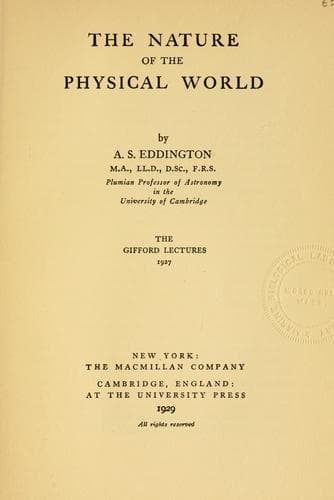
The nature of the physical worldEddington, Arthur Stanley, Sir
Philosophy
The nature of the physical world
Eddington, Arthur Stanley, Sir
Physics -- Philosophy; Science -- Philosophy
It is true that I have a strong impression of an external world apart
from any communication with other conscious beings. But apart from
such communication I should have no reason to trust the impression.
Most of our common impressions of substance, world-wide instants, and
so on, have turned out to be illusory, and the externality of the
world might be equally untrustworthy. The impression of externality is
equally strong in the world that comes to me in dreams; the dreamworld
is less rational, but that might be used as an argument in favour of
its externality as showing its dissociation from the internal faculty
of reason. So long as we have to deal with one consciousness alone,
the hypothesis that there is an external world responsible for part of
what appears in it is an idle one. All that can be asserted of this
external world is a mere duplication of the knowledge that can be much
more confidently asserted of the world appearing in the consciousness.
The hypothesis only becomes useful when it is the means of bringing
together the worlds of many consciousnesses occupying different
view-points.
The external world of physics is thus a symposium of the worlds
presented to different view-points. There is general agreement as to
the principles on which the symposium should be formed. Statements made
about this external world, if they are unambiguous, must be either
true or false. This has often been denied by philosophers. It is quite
commonly said that scientific theories about the world are neither
[Pg 285]
true nor false but merely convenient or inconvenient. A favourite
phrase is that the gauge of value of a scientific theory is that it
economises thought. Certainly a simple statement is preferable to a
circumlocutory one; and as regards any current scientific theory, it
is much easier to show that it is convenient or that it economises
thought than that it is true. But whatever lower standards we may
apply in practice we need not give up our ideals; and so long as there
is a distinction between true and false theories our aim must be to
eliminate the false. For my part I hold that the continual advance of
science is not a mere utilitarian progress; it is progress towards
ever purer truth. Only let it be understood that the truth we seek in
science is the truth about an external world propounded as the theme of
study, and is not bound up with any opinion as to the status of that
world—whether or not it wears the halo of reality, whether or not it
is deserving of “loud cheers”.
Public-domain text, read in full here on John Shaqi.
Reviews
Reviews
No reviews yet
Be the first to share your thoughts on this work.
Elsewhere in the archive
Join the Discussion
Join the discussion
Sign in to leave a comment or review.
Sign InorCreate an account