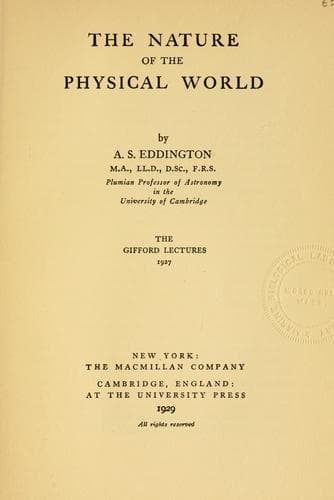
The nature of the physical worldEddington, Arthur Stanley, Sir
Philosophy
The nature of the physical world
Eddington, Arthur Stanley, Sir
Physics -- Philosophy; Science -- Philosophy
Predictability of Events. Let us examine a typical case of
successful scientific prediction. A total eclipse of the sun visible
in Cornwall is prophesied for 11 August 1999. It is generally supposed
that this eclipse is already predetermined by the present configuration
of the sun, earth and moon. I do not wish to arouse unnecessary
misgiving as to whether the eclipse will come off. I expect it will;
but let us examine the grounds of expectation. It is predicted as a
consequence of the law of gravitation—a law which we found in
chapter VII to be a mere truism. That
does not diminish the value of the prediction; but it does suggest
that we may not be able to pose as such marvellous prophets when we
come up against laws which are not mere truisms. I might venture to
predict that will be equal to 4 even in 1999; but if this
should prove correct it will not help to convince anyone that the
universe (or, if you like, the human mind) is governed by laws of
deterministic type. I suppose that in the most erratically governed
world something can be predicted if truisms are not excluded.
But we have to look deeper than this. The law of gravitation is only a
truism when regarded from a macroscopic point of view. It presupposes
space, and measurement with gross material or optical arrangements.
It cannot be refined to an accuracy beyond the limits of these gross
[Pg 300]
appliances; so that it is a truism with a probable error—small, but
not infinitely small. The classical laws hold good in the limit when
exceedingly large quantum numbers are involved. The system comprising
the sun, earth and moon has exceedingly high state-number (p. 198);
and the predictability of its configurations is not characteristic of
natural phenomena in general but of those involving great numbers of
atoms of action—such that we are concerned not with individual but
with average behaviour.
Human life is proverbially uncertain; few things are more certain
than the solvency of a life-insurance company. The average law is
so trustworthy that it may be considered predestined that half the
children now born will survive the age of years. But that does
not tell us whether the span of life of young A. McB. is already
written in the book of fate, or whether there is still time to alter it
by teaching him not to run in front of motor-buses. The eclipse in 1999
is as safe as the balance of a life-insurance company; the next quantum
jump of an atom is as uncertain as your life and mine.
Public-domain text, read in full here on John Shaqi.
Reviews
Reviews
No reviews yet
Be the first to share your thoughts on this work.
Elsewhere in the archive
Join the Discussion
Join the discussion
Sign in to leave a comment or review.
Sign InorCreate an account