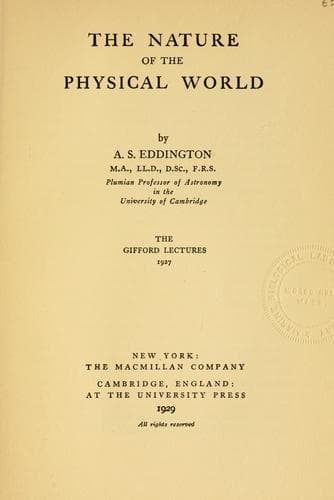
The nature of the physical worldEddington, Arthur Stanley, Sir
Philosophy
The nature of the physical world
Eddington, Arthur Stanley, Sir
Physics -- Philosophy; Science -- Philosophy
We are thus in a position to answer the main argument for a
predetermination of the future, viz. that observation shows the laws
of Nature to be of a type which leads to definite predictions of the
future, and it is reasonable to expect that any laws which remain
undiscovered will conform to the same type. For when we ask what
is the characteristic of the phenomena that have been successfully
predicted, the answer is that they are effects depending on the average
configurations of vast numbers of individual entities. But averages
are predictable because they are averages, irrespective of the type of
government of the phenomena underlying them.
[Pg 301]
Considering an atom alone in the world in State 3, the classical theory
would have asked, and hoped to answer, the question, What will it do
next? The quantum theory substitutes the question, Which will it do
next? Because it admits only two lower states for the atom to go to.
Further, it makes no attempt to find a definite answer, but contents
itself with calculating the respective odds on the jumps to State 1
and State 2. The quantum physicist does not fill the atom with gadgets
for directing its future behaviour, as the classical physicist would
have done; he fills it with gadgets determining the odds on its future
behaviour. He studies the art of the bookmaker not of the trainer.
Thus in the structure of the world as formulated in the new quantum
theory it is predetermined that of 500 atoms now in State 3,
approximately 400 will go on to State 1 and 100 to State 2—in so
far as anything subject to chance fluctuations can be said to be
predetermined. The odds of 4 to 1 find their appropriate representation
in the picture of the atom; that is to say, something symbolic of a
4:1 ratio is present in each of the 500 atoms. But there are no marks
distinguishing the atoms belonging to the group of 100 from the 400.
Probably most physicists would take the view that although the marks
are not yet shown in the picture, they are nevertheless present in
Nature; they belong to an elaboration of the theory which will come in
good time. The marks, of course, need not be in the atom itself; they
may be in the environment which will interact with it. For example, we
may load dice in such a way that the odds are 4 to 1 on throwing a 6.
Both those dice which turn up 6 and those which do not have these odds
written in their constitution—by a displaced position of the centre
of gravity. The result of a particular throw is not marked in the
[Pg 302]
dice; nevertheless it is strictly causal (apart perhaps from the human
element involved in throwing the dice) being determined by the external
influences which are concerned. Our own position at this stage is that
future developments of physics may reveal such causal marks (either
in the atom or in the influences outside it) or it may not. Hitherto
whenever we have thought we have detected causal marks in natural
Public-domain text, read in full here on John Shaqi.
Reviews
Reviews
No reviews yet
Be the first to share your thoughts on this work.
Elsewhere in the archive
Join the Discussion
Join the discussion
Sign in to leave a comment or review.
Sign InorCreate an account