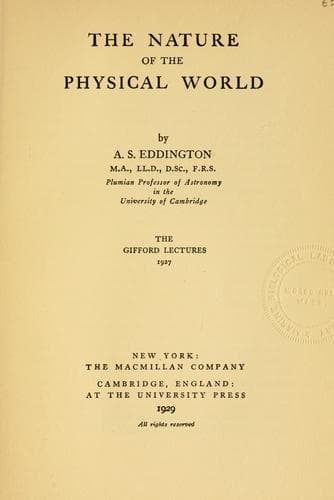
The nature of the physical worldEddington, Arthur Stanley, Sir
Philosophy
The nature of the physical world
Eddington, Arthur Stanley, Sir
Physics -- Philosophy; Science -- Philosophy
On the atomic scale of phenomena the probabilities are in general
well-balanced, and there are no “naps” for the scientific punter to
put his shirt on. If a body is still defined as a bundle of pointer
readings (or highly probable pointer readings) there are no “bodies” on
the atomic scale. All that we can extract is a bundle of probabilities.
That is in fact just how Schrödinger tries to picture the atom—as a
wave centre of his probability entity .
We commonly have had to deal with probabilities which arise through
ignorance. With fuller knowledge we should sweep away the references
to probability and substitute the exact facts. But it appears to be
a fundamental point in Schrödinger’s theory that his probabilities
are not to be replaced in that way. When his is sufficiently
concentrated it indicates the point where the electron is; when it is
diffused it gives only a vague indication of the position. But this
vague indication is not something which ideally ought to be replaced by
exact knowledge; it is itself which acts as the source of the
light emitted from the atom, the period of the light being that of the
beats of . I think this means that the spread of is
not a symbol for uncertainty arising through lack of information; it
[Pg 306]
is a symbol for causal failure—an indeterminacy of behaviour which is
part of the character of the atom.
We have two chief ways of learning about the interior of the atom. We
can observe electrons entering or leaving, and we can observe light
entering or leaving. Bohr has assumed a structure connected by strictly
causal law with the first phenomenon, Heisenberg and his followers
with the second. If the two structures were identifiable then the
atom would involve a complete causal connection of the two types of
phenomena. But apparently no such causal linkage exists. Therefore we
have to be content with a correlation in which the entities of the one
model represent probabilities in the second model. There are perhaps
details in the two theories which do not quite square with this; but
it seems to express the ideal to be aimed at in describing the laws
of an incompletely causal world, viz. that the causal source of one
phenomenon shall represent the probability of causal source of another
phenomenon. Schrödinger’s theory has given at least a strong hint that
the actual world is controlled on this plan.
The Principle of Indeterminacy. Thus far we have shown that
modern physics is drifting away from the postulate that the future is
predetermined, ignoring it rather than deliberately rejecting it. With
the discovery of the Principle of Indeterminacy (p. 220) its attitude
has become more definitely hostile.
Public-domain text, read in full here on John Shaqi.
Reviews
Reviews
No reviews yet
Be the first to share your thoughts on this work.
Elsewhere in the archive
Join the Discussion
Join the discussion
Sign in to leave a comment or review.
Sign InorCreate an account