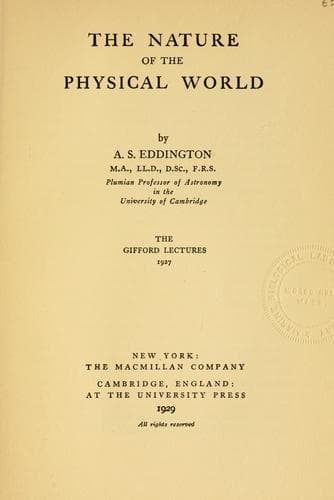
The nature of the physical worldEddington, Arthur Stanley, Sir
Philosophy
The nature of the physical world
Eddington, Arthur Stanley, Sir
Physics -- Philosophy; Science -- Philosophy
The New Epistemological Outlook. Scientific investigation does
not lead to knowledge of the intrinsic nature of things. “Whenever we
state the properties of a body in terms of physical quantities we are
[Pg 304]
imparting knowledge of the response of various metrical indicators to
its presence and nothing more” (p. 257). But if a body is not acting
according to strict causality, if there is an element of uncertainty as
to the response of the indicators, we seem to have cut away the ground
for this kind of knowledge. It is not predetermined what will be the
reading of the weighing-machine if the body is placed on it, therefore
the body has no definite mass; nor where it will be found an instant
hence, therefore it has no definite velocity; nor where the rays now
being reflected from it will converge in the microscope, therefore it
has no definite position; and so on. It is no use answering that the
body really has a definite mass, velocity, position, etc., which we
are unaware of; that statement, if it means anything, refers to an
intrinsic nature of things outside the scope of scientific knowledge.
We cannot infer these properties with precision from anything that we
can be aware of, because the breach of causality has broken the chain
of inference. Thus our knowledge of the response of indicators to
the presence of the body is non-existent; therefore we cannot assert
knowledge of it at all. So what is the use of talking about it? The
body which was to be the abstraction of all these (as yet unsettled)
pointer readings has become superfluous in the physical world. That
is the dilemma into which the old epistemology leads us as soon as we
begin to doubt strict causality.
In phenomena on a gross scale this difficulty can be got round. A
body may have no definite position but yet have within close limits
an extremely probable position. When the probabilities are large the
substitution of probability for certainty makes little difference;
it adds only a negligible haziness to the world. But though the
[Pg 305]
practical change is unimportant there are fundamental theoretical
consequences. All probabilities rest on a basis of a priori
probability, and we cannot say whether probabilities are large or
small without having assumed such a basis. In agreeing to accept those
of our calculated probabilities which are very high as virtually
equivalent to certainties on the old scheme, we are as it were making
our adopted basis of a priori probability a constituent of the
world-structure—adding to the world a kind of symbolic texture that
cannot be expressed on the old scheme.
Public-domain text, read in full here on John Shaqi.
Reviews
Reviews
No reviews yet
Be the first to share your thoughts on this work.
Elsewhere in the archive
Join the Discussion
Join the discussion
Sign in to leave a comment or review.
Sign InorCreate an account