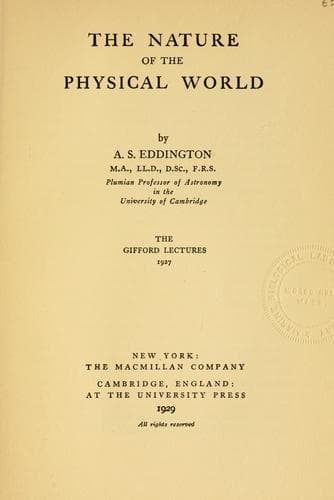
The nature of the physical worldEddington, Arthur Stanley, Sir
Philosophy
The nature of the physical world
Eddington, Arthur Stanley, Sir
Physics -- Philosophy; Science -- Philosophy
The same principle extends to every kind of phenomenon that we attempt
to predict, so long as the need for accuracy is not buried under a mass
of averages. To every co-ordinate there corresponds a momentum, and by
the principle of indeterminacy the more accurately the co-ordinate is
known the less accurately the momentum is known. Nature thus provides
that knowledge of one-half of the world will ensure ignorance of the
other half—ignorance which, we have seen, may be remedied later when
the same part of the world is contemplated retrospectively. We can
scarcely rest content with a picture of the world which includes so
much that cannot be known. We have been trying to get rid of unknowable
things, i.e. all conceptions which have no causal connection with our
experience. We have eliminated velocity through aether, “right” frames
of space, etc., for this reason. This vast new unknowable element
must likewise be swept out of the Present. Its proper place is in the
Future because then it will no longer be unknowable. It has been put in
prematurely as an anticipation of that which cannot be anticipated.
In assessing whether the symbols which the physicist has scattered
through the external world are adequate to predetermine the future,
we must be on our guard against retrospective symbols. It is easy to
prophesy after the event.
[Pg 309]
Natural and Supernatural. A rather serious consequence of
dropping causality in the external world is that it leaves us with
no clear distinction between the Natural and the Supernatural. In an
earlier chapter I compared the invisible agent invented to account
for the tug of gravitation to a “demon”. Is a view of the world which
admits such an agent any more scientific than that of a savage who
attributes all that he finds mysterious in Nature to the work of
invisible demons? The Newtonian physicist had a valid defence. He could
point out that his demon Gravitation was supposed to act according
to fixed causal laws and was therefore not to be compared with the
irresponsible demons of the savage. Once a deviation from strict
causality is admitted the distinction melts away. I suppose that the
savage would admit that his demon was to some extent a creature of
habit and that it would be possible to make a fair guess as to what
he would do in the future; but that sometimes he would show a will of
his own. It is that imperfect consistency which formerly disqualified
him from admission as an entity of physics along with his brother
Gravitation.
Public-domain text, read in full here on John Shaqi.
Reviews
Reviews
No reviews yet
Be the first to share your thoughts on this work.
Elsewhere in the archive
Join the Discussion
Join the discussion
Sign in to leave a comment or review.
Sign InorCreate an account