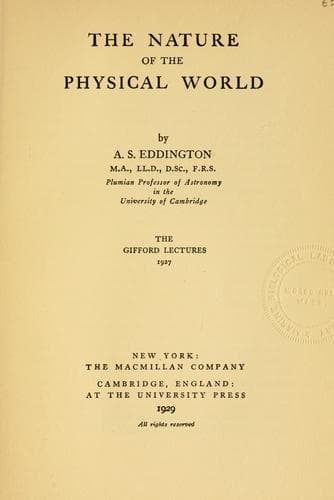
The nature of the physical worldEddington, Arthur Stanley, Sir
Philosophy
The nature of the physical world
Eddington, Arthur Stanley, Sir
Physics -- Philosophy; Science -- Philosophy
That is largely why there has been so much bother about “me”; because
I have, or am persuaded that I have, “a will of my own”. Either the
physicist must leave his causal scheme at the mercy of supernatural
interference from me, or he must explain away my supernatural
qualities. In self-defence the materialist favoured the latter course;
he decided that I was not supernatural—only complicated. We on the
other hand have concluded that there is no strict causal behaviour
anywhere. We can scarcely deny the charge that in abolishing the
criterion of causality we are opening the door to the savage’s demons.
It is a serious step, but I do not think it means the end of all true
[Pg 310]
science. After all if they try to enter we can pitch them out again, as
Einstein pitched out the respectable causal demon who called himself
Gravitation. It is a privation to be no longer able to stigmatise
certain views as unscientific superstition; but we are still
allowed, if the circumstances justify it, to reject them as bad
science.
Volition. From the philosophic point of view it is of deep
interest to consider how this affects the freedom of the human mind
and spirit. A complete determinism of the material universe cannot
be divorced from determinism of the mind. Take, for example, the
prediction of the weather this time next year. The prediction is not
likely ever to become practicable, but “orthodox” physicists are not
yet convinced that it is theoretically impossible; they hold that next
year’s weather is already predetermined. We should require extremely
detailed knowledge of present conditions, since a small local deviation
can exert an ever-expanding influence. We must examine the state of
the sun so as to predict the fluctuations in the heat and corpuscular
radiation which it sends us. We must dive into the bowels of the earth
to be forewarned of volcanic eruptions which may spread a dust screen
over the atmosphere as Mt. Katmai did some years ago. But further we
must penetrate into the recesses of the human mind. A coal strike,
a great war, may directly change the conditions of the atmosphere;
a lighted match idly thrown away may cause deforestation which will
change the rainfall and climate. There can be no fully deterministic
control of inorganic phenomena unless the determinism governs mind
itself. Conversely if we wish to emancipate mind we must to some extent
emancipate the material world also. There appears to be no longer any
[Pg 311]
obstacle to this emancipation.
Public-domain text, read in full here on John Shaqi.
Reviews
Reviews
No reviews yet
Be the first to share your thoughts on this work.
Elsewhere in the archive
Join the Discussion
Join the discussion
Sign in to leave a comment or review.
Sign InorCreate an account