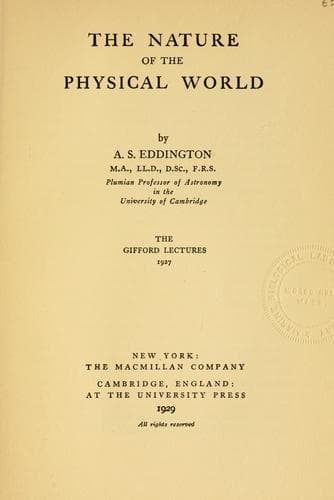
The nature of the physical worldEddington, Arthur Stanley, Sir
Philosophy
The nature of the physical world
Eddington, Arthur Stanley, Sir
Physics -- Philosophy; Science -- Philosophy
But we must pause to consider the extent of the illusion. Is it a
question of a small nugget of reality buried under a mountain of
illusion? If that were so it would be our duty to rid our minds of some
of the illusion at least, and try to know the truth in purer form.
[Pg 321]
But I cannot think there is much amiss with our appreciation of the
natural scene that so impresses us. I do not think a being more highly
endowed than ourselves would prune away much of what we feel. It is not
so much that the feeling itself is at fault as that our introspective
examination of it wraps it in fanciful imagery. If I were to try to put
into words the essential truth revealed in the mystic experience, it
would be that our minds are not apart from the world; and the feelings
that we have of gladness and melancholy and our yet deeper feelings
are not of ourselves alone, but are glimpses of a reality transcending
the narrow limits of our particular consciousness—that the harmony
and beauty of the face of Nature is at root one with the gladness that
transfigures the face of man. We try to express much the same truth
when we say that the physical entities are only an extract of pointer
readings and beneath them is a nature continuous with our own. But I do
not willingly put it into words or subject it to introspection. We have
seen how in the physical world the meaning is greatly changed when we
contemplate it as surveyed from without instead of, as it essentially
must be, from within. By introspection we drag out the truth for
external survey; but in the mystical feeling the truth is apprehended
from within and is, as it should be, a part of ourselves.
Symbolic Knowledge and Intimate Knowledge. May I elaborate this
objection to introspection? We have two kinds of knowledge which I
call symbolic knowledge and intimate knowledge. I do not know whether
it would be correct to say that reasoning is only applicable to
symbolic knowledge, but the more customary forms of reasoning have been
developed for symbolic knowledge only. The intimate knowledge will not
[Pg 322]
submit to codification and analysis; or, rather, when we attempt to
analyse it the intimacy is lost and it is replaced by symbolism.
Public-domain text, read in full here on John Shaqi.
Reviews
Reviews
No reviews yet
Be the first to share your thoughts on this work.
Elsewhere in the archive
Join the Discussion
Join the discussion
Sign in to leave a comment or review.
Sign InorCreate an account