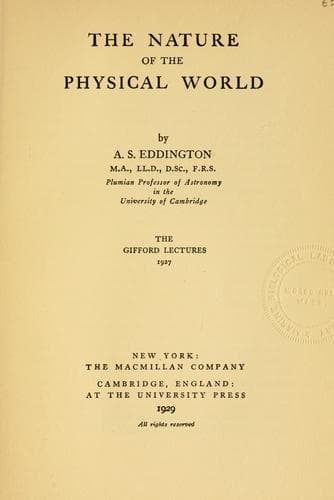
The nature of the physical worldEddington, Arthur Stanley, Sir
Philosophy
The nature of the physical world
Eddington, Arthur Stanley, Sir
Physics -- Philosophy; Science -- Philosophy
To put a plain question—Why should it be good for us to experience
a state of self-deception such as I have described? I think everyone
admits that it is good to have a spirit sensitive to the influences of
Nature, good to exercise an appreciative imagination and not always to
be remorselessly dissecting our environment after the manner of the
mathematical physicists. And it is good not merely in a utilitarian
sense, but in some purposive sense necessary to the fulfilment of the
life that is given us. It is not a dope which it is expedient to take
[Pg 320]
from time to time so that we may return with greater vigour to the
more legitimate employment of the mind in scientific investigation.
Just possibly it might be defended on the ground that it affords to
the non-mathematical mind in some feeble measure that delight in the
external world which would be more fully provided by an intimacy with
its differential equations. (Lest it should be thought that I have
intended to pillory hydrodynamics, I hasten to say in this connection
that I would not rank the intellectual (scientific) appreciation on
a lower plane than the mystical appreciation; and I know of passages
written in mathematical symbols which in their sublimity might vie with
Rupert-Brooke’s sonnet.) But I think you will agree with me that it is
impossible to allow that the one kind of appreciation can adequately
fill the place of the other. Then how can it be deemed good if there
is nothing in it but self-deception? That would be an upheaval of all
our ideas of ethics. It seems to me that the only alternatives are
either to count all such surrender to the mystical contact of Nature
as mischievous and ethically wrong, or to admit that in these moods
we catch something of the true relation of the world to ourselves—a
relation not hinted at in a purely scientific analysis of its content.
I think the most ardent materialist does not advocate, or at any rate
does not practice, the first alternative; therefore I assume the second
alternative, that there is some kind of truth at the base of the
illusion.
Public-domain text, read in full here on John Shaqi.
Reviews
Reviews
No reviews yet
Be the first to share your thoughts on this work.
Elsewhere in the archive
Join the Discussion
Join the discussion
Sign in to leave a comment or review.
Sign InorCreate an account