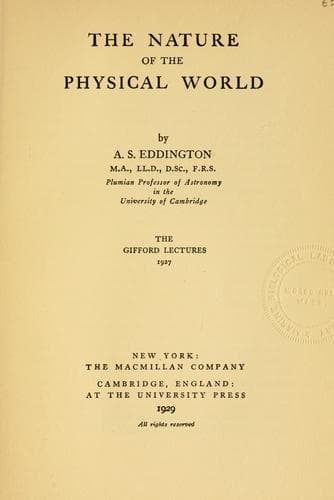
The nature of the physical worldEddington, Arthur Stanley, Sir
Philosophy
The nature of the physical world
Eddington, Arthur Stanley, Sir
Physics -- Philosophy; Science -- Philosophy
The mystic, if haled before a tribunal of scientists, might perhaps
end his defence on this note. He would say, The familiar material
world of everyday conception, though lacking somewhat in scientific
truth, is good enough to live in; in fact the scientific world of
pointer readings would be an impossible sort of place to inhabit. It
is a symbolic world and the only thing that could live comfortably in
it would be a symbol. But I am not a symbol; I am compounded
of that mental activity which is from your point of view a nest of
illusion, so that to accord with my own nature I have to transform even
the world explored by my senses. But I am not merely made up of senses;
the rest of my nature has to live and grow. I have to render account
of that environment into which it has its outlet. My conception of my
spiritual environment is not to be compared with your scientific world
of pointer readings; it is an everyday world to be compared with the
material world of familiar experience. I claim it as no more real and
no less real than that. Primarily it is not a world to be analysed, but
a world to be lived in.
Granted that this takes us outside the sphere of exact knowledge, and
[Pg 325]
that it is difficult to imagine that anything corresponding to exact
science will ever be applicable to this part of our environment, the
mystic is unrepentant. Because we are unable to render exact account of
our environment it does not follow that it would be better to pretend
that we live in a vacuum.
If the defence may be considered to have held good against the first
onslaught, perhaps the next stage of the attack will be an easy
tolerance. “Very well. Have it your own way. It is a harmless sort of
belief—not like a more dogmatic theology. You want a sort of spiritual
playground for those queer tendencies in man’s nature, which sometimes
take possession of him. Run away and play then; but do not bother the
serious people who are making the world go round.” The challenge now
comes not from the scientific materialism which professes to seek a
natural explanation of spiritual power, but from the deadlier moral
materialism which despises it. Few deliberately hold the philosophy
that the forces of progress are related only to the material side of
our environment, but few can claim that they are not more or less
under its sway. We must not interrupt the “practical men”, these busy
moulders of history carrying us at ever-increasing pace towards our
destiny as an ant-heap of humanity infesting the earth. But is it true
in history that material forces have been the most potent factors? Call
it of God, of the Devil, fanaticism, unreason; but do not underrate the
power of the mystic. Mysticism may be fought as error or believed as
inspired, but it is no matter for easy tolerance—
We are the music-makers
And we are the dreamers of dreams
Wandering by lone sea-breakers
And sitting by desolate streams;
[Pg 326]
Public-domain text, read in full here on John Shaqi.
Reviews
Reviews
No reviews yet
Be the first to share your thoughts on this work.
Elsewhere in the archive