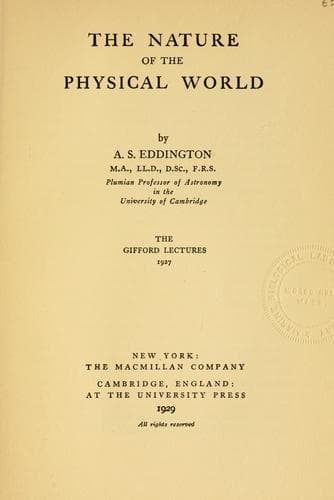
The nature of the physical worldEddington, Arthur Stanley, Sir
Philosophy
The nature of the physical world
Eddington, Arthur Stanley, Sir
Physics -- Philosophy; Science -- Philosophy
A rainbow described in the symbolism of physics is a band of aethereal
vibrations arranged in systematic order of wave-length from about
.000040 cm. to .000072 cm. From one point of view we are paltering
[Pg 329]
with the truth whenever we admire the gorgeous bow of colour, and
should strive to reduce our minds to such a state that we receive the
same impression from the rainbow as from a table of wave-lengths. But
although that is how the rainbow impresses itself on an impersonal
spectroscope, we are not giving the whole truth and significance of
experience—the starting-point of the problem—if we suppress the
factors wherein we ourselves differ from a spectroscope. We cannot say
that the rainbow, as part of the world, was meant to convey the vivid
effects of colour; but we can perhaps say that the human mind as part
of the world was meant to perceive it that way.
Significance and Values. When we think of the sparkling waves
as moved with laughter we are evidently attributing a significance to
the scene which was not there. The physical elements of the water—the
scurrying electric charges—were guiltless of any intention to convey
the impression that they were happy. But so also were they guiltless
of any intention to convey the impression of substance, of colour, or
of geometrical form of the waves. If they can be held to have had any
intention at all it was to satisfy certain differential equations—and
that was because they are the creatures of the mathematician who has a
partiality for differential equations. The physical no less than the
mystical significance of the scene is not there; it is here—in
the mind.
What we make of the world must be largely dependent on the sense-organs
that we happen to possess. How the world must have changed since man
came to rely on his eyes rather than his nose! You are alone on the
mountains wrapt in a great silence; but equip yourself with an extra
[Pg 330]
artificial sense-organ and, lo! the aether is hideous with the blare of
the Savoy bands. Or—
The isle is full of noises,
Sounds, and sweet airs, that give delight, and hurt not.
Sometimes a thousand twangling instruments
Will hum about mine ears; and sometimes voices.
Public-domain text, read in full here on John Shaqi.
Reviews
Reviews
No reviews yet
Be the first to share your thoughts on this work.
Elsewhere in the archive
Join the Discussion
Join the discussion
Sign in to leave a comment or review.
Sign InorCreate an account