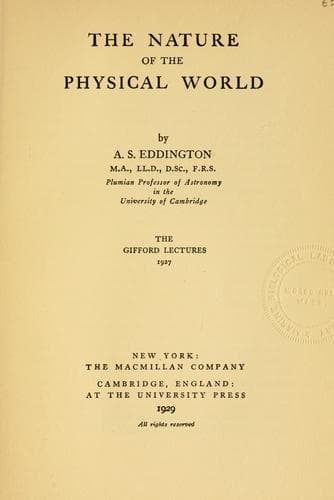
The nature of the physical worldEddington, Arthur Stanley, Sir
Philosophy
The nature of the physical world
Eddington, Arthur Stanley, Sir
Physics -- Philosophy; Science -- Philosophy
So far as broader characteristics are concerned we see in Nature what
we look for or are equipped to look for. Of course, I do not mean
that we can arrange the details of the scene; but by the light and
shade of our values we can bring out things that shall have the broad
characteristics we esteem. In this sense the value placed on permanence
creates the world of apparent substance; in this sense, perhaps, the
God within creates the God in Nature. But no complete view can be
obtained so long as we separate our consciousness from the world of
which it is a part. We can only speak speculatively of that which I
have called the “background of the pointer readings”; but it would
at least seem plausible that if the values which give the light and
shade of the world are absolute they must belong to the background,
unrecognised in physics because they are not in the pointer readings
but recognised by consciousness which has its roots in the background.
I have no wish to put that forward as a theory; it is only to emphasise
that, limited as we are to a knowledge of the physical world and its
points of contact with the background in isolated consciousness, we
do not quite attain that thought of the unity of the whole which is
essential to a complete theory. Presumably human nature has been
specialised to a considerable extent by the operation of natural
selection; and it might well be debated whether its valuation of
permanence and other traits now apparently fundamental are essential
[Pg 331]
properties of consciousness or have been evolved through interplay
with the external world. In that case the values given by mind to
the external world have originally come to it from the external
world-stuff. Such a tossing to and fro of values is, I think, not
foreign to our view that the world-stuff behind the pointer readings is
of nature continuous with the mind.
In viewing the world in a practical way values for normal human
consciousness may be taken as standard. But the evident possibility
of arbitrariness in this valuation sets us hankering after a standard
that could be considered final and absolute. We have two alternatives.
Either there are no absolute values, so that the sanctions of the
inward monitor in our consciousness are the final court of appeal
beyond which it is idle to inquire. Or there are absolute values;
then we can only trust optimistically that our values are some pale
reflection of those of the Absolute Valuer, or that we have insight
into the mind of the Absolute from whence come those strivings and
sanctions whose authority we usually forbear to question.
Public-domain text, read in full here on John Shaqi.
Reviews
Reviews
No reviews yet
Be the first to share your thoughts on this work.
Elsewhere in the archive
Join the Discussion
Join the discussion
Sign in to leave a comment or review.
Sign InorCreate an account