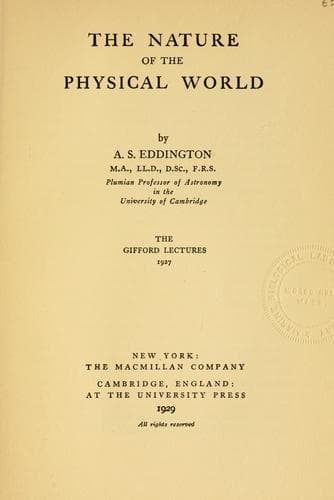
The nature of the physical worldEddington, Arthur Stanley, Sir
Philosophy
The nature of the physical world
Eddington, Arthur Stanley, Sir
Physics -- Philosophy; Science -- Philosophy
May I revert again to the analogy of theology with the supposed science
of humour which (after consultation with a classical authority) I
venture to christen “geloeology”. Analogy is not convincing argument,
but it must serve here. Consider the proverbial Scotchman with strong
leanings towards philosophy and incapable of seeing a joke. There
[Pg 336]
is no reason why he should not take high honours in geloeology,
and for example write an acute analysis of the differences between
British and American humour. His comparison of our respective jokes
would be particularly unbiased and judicial, seeing that he is quite
incapable of seeing the point of either. But it would be useless to
consider his views as to which was following the right development;
for that he would need a sympathetic understanding—he would (in
the phrase appropriate to the other side of my analogy) need to
be converted. The kind of help and criticism given by the
geloeologist and the philosophical theologian is to secure that there
is method in our madness. The former may show that our hilarious
reception of a speech is the result of a satisfactory dinner and a good
cigar rather than a subtle perception of wit; the latter may show that
the ecstatic mysticism of the anchorite is the vagary of a fevered body
and not a transcendent revelation. But I do not think we should appeal
to either of them to discuss the reality of the sense with which we
claim to be endowed, nor the direction of its right development. That
is a matter for our inner sense of values which we all believe in to
some extent, though it may be a matter of dispute just how far it goes.
If we have no such sense then it would seem that not only religion, but
the physical world and all faith in reasoning totter in insecurity.
I have sometimes been asked whether science cannot now furnish an
argument which ought to convince any reasonable atheist. I could no
more ram religious conviction into an atheist than I could ram a joke
into the Scotchman. The only hope of “converting” the latter is that
through contact with merry-minded companions he may begin to realise
that he is missing something in life which is worth attaining.
[Pg 337]
Probably in the recesses of his solemn mind there exists inhibited the
seed of humour, awaiting an awakening by such an impulse. The same
advice would seem to apply to the propagation of religion; it has, I
believe, the merit of being entirely orthodox advice.
Public-domain text, read in full here on John Shaqi.
Reviews
Reviews
No reviews yet
Be the first to share your thoughts on this work.
Elsewhere in the archive
Join the Discussion
Join the discussion
Sign in to leave a comment or review.
Sign InorCreate an account