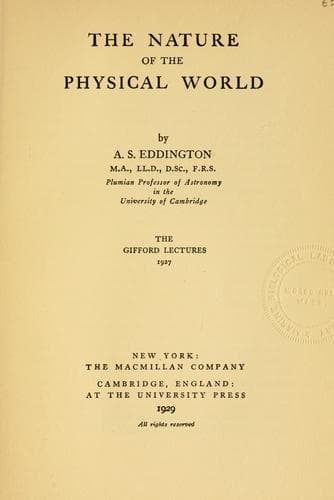
The nature of the physical worldEddington, Arthur Stanley, Sir
Philosophy
The nature of the physical world
Eddington, Arthur Stanley, Sir
Physics -- Philosophy; Science -- Philosophy
We cannot pretend to offer proofs. Proof is an idol before whom
the pure mathematician tortures himself. In physics we are generally
content to sacrifice before the lesser shrine of Plausibility.
And even the pure mathematician—that stern logician—reluctantly
allows himself some prejudgments; he is never quite convinced that the
scheme of mathematics is flawless, and mathematical logic has undergone
revolutions as profound as the revolutions of physical theory. We are
all alike stumblingly pursuing an ideal beyond our reach. In science we
sometimes have convictions as to the right solution of a problem which
we cherish but cannot justify; we are influenced by some innate sense
of the fitness of things. So too there may come to us convictions in
the spiritual sphere which our nature bids us hold to. I have given an
example of one such conviction which is rarely if ever disputed—that
surrender to the mystic influence of a scene of natural beauty is right
and proper for a human spirit, although it would have been deemed an
unpardonable eccentricity in the “observer” contemplated in earlier
chapters. Religious conviction is often described in somewhat analogous
terms as a surrender; it is not to be enforced by argument on those who
do not feel its claim in their own nature.
I think it is inevitable that these convictions should emphasise a
personal aspect of what we are trying to grasp. We have to build the
spiritual world out of symbols taken from our own personality, as
we build the scientific world out of the metrical symbols of the
[Pg 338]
mathematician. If not, it can only be left ungraspable—an environment
dimly felt in moments of exaltation but lost to us in the sordid
routine of life. To turn it into more continuous channels we must be
able to approach the World-Spirit in the midst of our cares and duties
in that simpler relation of spirit to spirit in which all true religion
finds expression.
Mystical Religion. We have seen that the cyclic scheme
of physics presupposes a background outside the scope of its
investigations. In this background we must find, first, our own
personality, and then perhaps a greater personality. The idea of
a universal Mind or Logos would be, I think, a fairly plausible
inference from the present state of scientific theory; at least it is
in harmony with it. But if so, all that our inquiry justifies us in
asserting is a purely colourless pantheism. Science cannot tell whether
the world-spirit is good or evil, and its halting argument for the
existence of a God might equally well be turned into an argument for
the existence of a Devil.
Public-domain text, read in full here on John Shaqi.
Reviews
Reviews
No reviews yet
Be the first to share your thoughts on this work.
Elsewhere in the archive
Join the Discussion
Join the discussion
Sign in to leave a comment or review.
Sign InorCreate an account