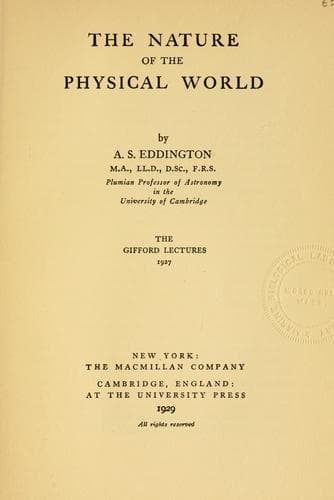
The nature of the physical worldEddington, Arthur Stanley, Sir
Philosophy
The nature of the physical world
Eddington, Arthur Stanley, Sir
Physics -- Philosophy; Science -- Philosophy
I suppose the most sweeping charge will be that I have been talking
what at the back of my mind I must know is only a well-meaning kind of
nonsense. I can assure you that there is a scientific part of me that
has often brought that criticism during some of the later chapters.
I will not say that I have been half-convinced, but at least I have
felt a homesickness for the paths of physical science where there
are more or less discernible handrails to keep us from the worst
morasses of foolishness. But however much I may have felt inclined to
tear up this part of the discussion and confine myself to my proper
profession of juggling with pointer readings, I find myself holding
to the main principles. Starting from aether, electrons and other
physical machinery we cannot reach conscious man and render count
of what is apprehended in his consciousness. Conceivably we might
reach a human machine interacting by reflexes with its environment;
but we cannot reach rational man morally responsible to pursue the
truth as to aether and electrons or to religion. Perhaps it may seem
unnecessarily portentous to invoke the latest developments of the
relativity and quantum theories merely to tell you this; but that
is scarcely the point. We have followed these theories because they
contain the conceptions of modern science; and it is not a question of
asserting a faith that science must ultimately be reconcilable with
an idealistic view, but of examining how at the moment it actually
[Pg 344]
stands in regard to it. I might sacrifice the detailed arguments of
the last four chapters (perhaps marred by dialectic entanglement) if I
could otherwise convey the significance of the recent change which has
overtaken scientific ideals. The physicist now regards his own external
world in a way which I can only describe as more mystical, though not
less exact and practical, than that which prevailed some years ago,
when it was taken for granted that nothing could be true unless an
engineer could make a model of it. There was a time when the whole
combination of self and environment which makes up experience seemed
likely to pass under the dominion of a physics much more iron-bound
than it is now. That overweening phase, when it was almost necessary to
ask the permission of physics to call one’s soul one’s own, is past.
The change gives rise to thoughts which ought to be developed. Even
if we cannot attain to much clarity of constructive thought we can
discern that certain assumptions, expectations or fears are no longer
applicable.
Is it merely a well-meaning kind of nonsense for a physicist to affirm
this necessity for an outlook beyond physics? It is worse nonsense to
deny it. Or as that ardent relativist the Red Queen puts it, “You call
that nonsense, but I’ve heard nonsense compared with which that would
be as sensible as a dictionary”.
Public-domain text, read in full here on John Shaqi.
Reviews
Reviews
No reviews yet
Be the first to share your thoughts on this work.
Elsewhere in the archive
Join the Discussion
Join the discussion
Sign in to leave a comment or review.
Sign InorCreate an account