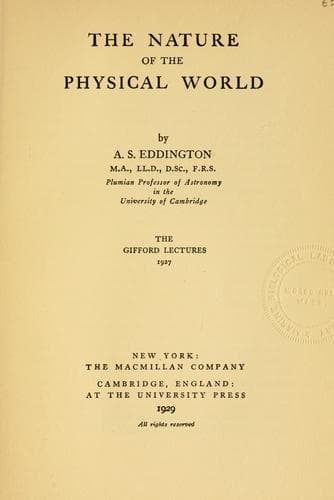
The nature of the physical worldEddington, Arthur Stanley, Sir
Philosophy
The nature of the physical world
Eddington, Arthur Stanley, Sir
Physics -- Philosophy; Science -- Philosophy
For if those who hold that there must be a physical basis for
everything hold that these mystical views are nonsense, we may
ask—What then is the physical basis of nonsense? The “problem of
nonsense” touches the scientist more nearly than any other moral
problem. He may regard the distinction of good and evil as too remote
to bother about; but the distinction of sense and nonsense, of valid
and invalid reasoning, must be accepted at the beginning of every
[Pg 345]
scientific inquiry. Therefore it may well be chosen for examination as
a test case.
If the brain contains a physical basis for the nonsense which it
thinks, this must be some kind of configuration of the entities of
physics—not precisely a chemical secretion, but not essentially
different from that kind of product. It is as though when my brain says
7 times 8 are 56 its machinery is manufacturing sugar, but when it
says 7 times 8 are 65 the machinery has gone wrong and produced chalk.
But who says the machinery has gone wrong? As a physical machine the
brain has acted according to the unbreakable laws of physics; so why
stigmatise its action? This discrimination of chemical products as
good or evil has no parallel in chemistry. We cannot assimilate laws
of thought to natural laws; they are laws which ought to be
obeyed, not laws which must be obeyed; and the physicist must
accept laws of thought before he accepts natural law. “Ought” takes
us outside chemistry and physics. It concerns something which wants
or esteems sugar, not chalk, sense, not nonsense. A physical machine
cannot esteem or want anything; whatever is fed into it it will chaw
up according to the laws of its physical machinery. That which in the
physical world shadows the nonsense in the mind affords no ground
for its condemnation. In a world of aether and electrons we might
perhaps encounter nonsense; we could not encounter damned
nonsense.
The most plausible physical theory of correct reasoning would
probably run somewhat as follows. By reasoning we are sometimes able
to predict events afterwards confirmed by observation; the mental
processes follow a sequence ending in a conception which anticipates
a subsequent perception. We may call such a chain of mental states
[Pg 346]
“successful reasoning”—intended as a technical classification without
any moral implications involving the awkward word “ought”. We can
examine what are the common characteristics of various pieces of
successful reasoning. If we apply this analysis to the mental aspects
of the reasoning we obtain laws of logic; but presumably the analysis
could also be applied to the physical constituents of the brain. It
is not unlikely that a distinctive characteristic would be found in
the physical processes in the brain-cells which accompany successful
reasoning, and this would constitute “the physical basis of success.”
Public-domain text, read in full here on John Shaqi.
Reviews
Reviews
No reviews yet
Be the first to share your thoughts on this work.
Elsewhere in the archive
Join the Discussion
Join the discussion
Sign in to leave a comment or review.
Sign InorCreate an account