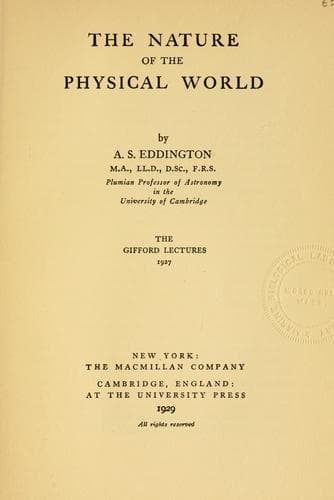
The nature of the physical worldEddington, Arthur Stanley, Sir
Philosophy
The nature of the physical world
Eddington, Arthur Stanley, Sir
Physics -- Philosophy; Science -- Philosophy
But we do not use reasoning power solely to predict observational
events, and the question of success (as above defined) does not always
arise. Nevertheless if such reasoning were accompanied by the product
which I have called “the physical basis of success” we should naturally
assimilate it to successful reasoning.
And so if I persuade my materialist opponent to withdraw the epithet
“damned nonsense” as inconsistent with his own principles he is still
entitled to allege that my brain in evolving these ideas did not
contain the physical basis of success. As there is some danger of our
respective points of view becoming mixed up, I must make clear my
contention:
(a) If I thought like my opponent I should not worry about the
alleged absence of a physical basis of success in my reasoning, since
it is not obvious why this should be demanded when we are not dealing
with observational predictions.
(b) As I do not think like him, I am deeply perturbed by the
allegation; because I should consider it to be the outward sign
that the stronger epithet (which is not inconsistent with my
principles) is applicable.
[Pg 347]
I think that the “success” theory of reasoning will not be much
appreciated by the pure mathematician. For him reasoning is a
heaven-sent faculty to be enjoyed remote from the fuss of external
Nature. It is heresy to suggest that the status of his demonstrations
depends on the fact that a physicist now and then succeeds in
predicting results which accord with observation. Let the external
world behave as irrationally as it will, there will remain undisturbed
a corner of knowledge where he may happily hunt for the roots of
the Riemann-Zeta function. The “success” theory naturally justifies
itself to the physicist. He employs this type of activity of the brain
because it leads him to what he wants—a verifiable prediction as to
the external world—and for that reason he esteems it. Why should
not the theologian employ and esteem one of the mental processes of
unreason which leads to what he wants—an assurance of future bliss, or
a Hell to frighten us into better behaviour? Understand that I do not
encourage theologians to despise reason; my point is that they might
well do so if it had no better justification than the “success” theory.
And so my own concern lest I should have been talking nonsense ends
in persuading me that I have to reckon with something that could not
possibly be found in the physical world.
Public-domain text, read in full here on John Shaqi.
Reviews
Reviews
No reviews yet
Be the first to share your thoughts on this work.
Elsewhere in the archive
Join the Discussion
Join the discussion
Sign in to leave a comment or review.
Sign InorCreate an account