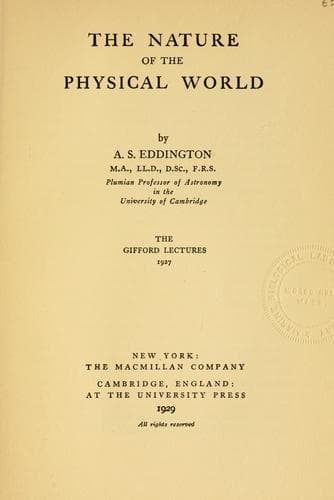
The nature of the physical worldEddington, Arthur Stanley, Sir
Philosophy
The nature of the physical world
Eddington, Arthur Stanley, Sir
Physics -- Philosophy; Science -- Philosophy
A besetting temptation of the scientific apologist for religion is to
take some of its current expressions and after clearing away crudities
[Pg 349]
of thought (which must necessarily be associated with anything adapted
to the everyday needs of humanity) to water down the meaning until
little is left that could possibly be in opposition to science or to
anything else. If the revised interpretation had first been presented
no one would have raised vigorous criticism; on the other hand no one
would have been stirred to any great spiritual enthusiasm. It is the
less easy to steer clear of this temptation because it is necessarily a
question of degree. Clearly if we are to extract from the tenets of a
hundred different sects any coherent view to be defended some at least
of them must be submitted to a watering-down process. I do not know
if the reader will acquit me of having succumbed to this temptation
in the passages where I have touched upon religion; but I have tried
to make a fight against it. Any apparent failure has probably arisen
in the following way. We have been concerned with the borderland of
the material and spiritual worlds as approached from the side of the
former. From this side all that we could assert of the spiritual world
would be insufficient to justify even the palest brand of theology
that is not too emaciated to have any practical influence on man’s
outlook. But the spiritual world as understood in any serious religion
is by no means a colourless domain. Thus by calling this hinterland of
science a spiritual world I may seem to have begged a vital question,
whereas I intended only a provisional identification. To make it more
than provisional an approach must be made from the other side. I am
unwilling to play the amateur theologian, and examine this approach
in detail. I have, however, pointed out that the attribution of
religious colour to the domain must rest on inner conviction; and I
think we should not deny validity to certain inner convictions, which
[Pg 350]
seem parallel with the unreasoning trust in reason which is at the
basis of mathematics, with an innate sense of the fitness of things
which is at the basis of the science of the physical world, and with
an irresistible sense of incongruity which is at the basis of the
justification of humour. Or perhaps it is not so much a question of
asserting the validity of these convictions as of recognising their
function as an essential part of our nature. We do not defend the
validity of seeing beauty in a natural landscape; we accept with
gratitude the fact that we are so endowed as to see it that way.
Public-domain text, read in full here on John Shaqi.
Reviews
Reviews
No reviews yet
Be the first to share your thoughts on this work.
Elsewhere in the archive
Join the Discussion
Join the discussion
Sign in to leave a comment or review.
Sign InorCreate an account