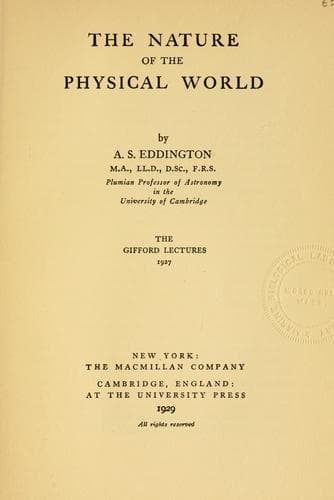
The nature of the physical worldEddington, Arthur Stanley, Sir
Philosophy
The nature of the physical world
Eddington, Arthur Stanley, Sir
Physics -- Philosophy; Science -- Philosophy
It will perhaps be said that the conclusion to be drawn from these
arguments from modern science, is that religion first became possible
for a reasonable scientific man about the year 1927. If we must
consider that tiresome person, the consistently reasonable man, we may
point out that not merely religion but most of the ordinary aspects
of life first became possible for him in that year. Certain common
activities (e.g. falling in love) are, I fancy, still forbidden him.
If our expectation should prove well founded that 1927 has seen the
final overthrow of strict causality by Heisenberg, Bohr, Born and
others, the year will certainly rank as one of the greatest epochs
in the development of scientific philosophy. But seeing that before
this enlightened era men managed to persuade themselves that they
had to mould their own material future notwithstanding the yoke of
strict causality, they might well use the same modus vivendi in
religion.
This brings us to consider the view often pontifically asserted that
there can be no conflict between science and religion because they
belong to altogether different realms of thought. The implication
is that discussions such as we have been pursuing are superfluous.
But it seems to me rather that the assertion challenges this kind
[Pg 351]
of discussion—to see how both realms of thought can be associated
independently with our existence. Having seen something of the way
in which the scientific realm of thought has constituted itself out
of a self-closed cyclic scheme we are able to give a guarded assent.
The conflict will not be averted unless both sides confine themselves
to their proper domain; and a discussion which enables us to reach
a better understanding as to the boundary should be a contribution
towards a state of peace. There is still plenty of opportunity for
frontier difficulties; a particular illustration will show this.
Public-domain text, read in full here on John Shaqi.
Reviews
Reviews
No reviews yet
Be the first to share your thoughts on this work.
Elsewhere in the archive
Join the Discussion
Join the discussion
Sign in to leave a comment or review.
Sign InorCreate an account