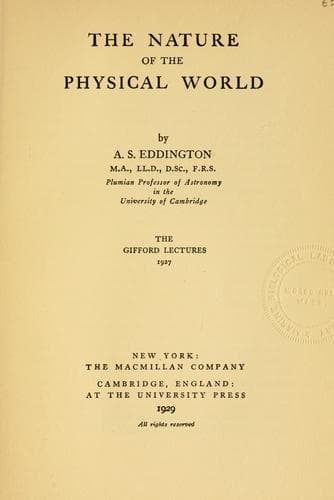
The nature of the physical worldEddington, Arthur Stanley, Sir
Philosophy
The nature of the physical world
Eddington, Arthur Stanley, Sir
Physics -- Philosophy; Science -- Philosophy
These revolutions of thought as to the final picture do not cause the
scientist to lose faith in his handiwork, for he is aware that the
completed portion is growing steadily. Those who look over his shoulder
and use the present partially developed picture for purposes outside
science, do so at their own risk.
The lack of finality of scientific theories would be a very serious
limitation of our argument, if we had staked much on their permanence.
The religious reader may well be content that I have not offered
him a God revealed by the quantum theory, and therefore liable to
be swept away in the next scientific revolution. It is not so much
the particular form that scientific theories have now taken—the
conclusions which we believe we have proved—as the movement of thought
behind them that concerns the philosopher. Our eyes once opened, we may
pass on to a yet newer outlook on the world, but we can never go back
to the old outlook.
If the scheme of philosophy which we now rear on the scientific
advances of Einstein, Bohr, Rutherford and others is doomed to fall in
the next thirty years, it is not to be laid to their charge that we
have gone astray. Like the systems of Euclid, of Ptolemy, of Newton,
which have served their turn, so the systems of Einstein and Heisenberg
may give way to some fuller realisation of the world. But in each
revolution of scientific thought new words are set to the old music,
and that which has gone before is not destroyed but refocussed. Amid
all our faulty attempts at expression the kernel of scientific truth
steadily grows; and of this truth it may be said—The more it changes,
the more it remains the same thing.
[50]
This difficulty is evidently connected with the dual
entry of time into our experience to which I have so often referred.
[Pg 355]
INDEX
A B C of physics, xiv, 88
A priori probability, 77, 244, 305
Absolute, 23, 56; past and future,
48, 57, 295; elsewhere, 49, 50;
values, 288, 331; future perfect,
307
Absorption of light, 184, 186
Abstractions, 53
Accelerated frames of reference, 113
Acceleration, relativity of, 129
Action, 180, 241; atom of, 182
Actuality, 266, 319
Aether, nature of, 31
Aether-drag, 3
Age of the sun, 169
And, study of, 104
Anthropomorphic conception of
deity, 282, 337, 341
Antisymmetrical properties of
world, 236
Ape-like ancestors, 16, 81, 273
Apple (Newton’s), 111, 115
Arrow, Time’s, 69, 79, 88, 295
Astronomer Royal’s time, 36, 40
Atom, structure of, 1, 190, 199, 224
Atom of action, 182. See Quantum
Atomicity, laws of, 236, 245
Averages, 300
Awareness, 16, 334
Background of pointer readings,
137, 255, 259, 268, 330, 339
Balance sheet, 33
Beats, 216
Beauty, 105, 267, 350
Becoming, 68, 87
Beginning of time, 83
Berkeley, Bishop, xii, 326
Beta () particle, 59
Bifurcation of the world, 236
Billiard ball atoms, 2, 259
Public-domain text, read in full here on John Shaqi.
Reviews
Reviews
No reviews yet
Be the first to share your thoughts on this work.
Elsewhere in the archive
Join the Discussion
Join the discussion
Sign in to leave a comment or review.
Sign InorCreate an account