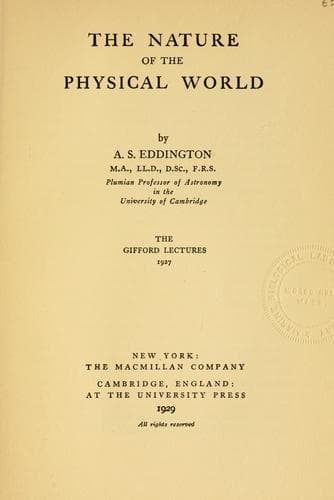
The nature of the physical worldEddington, Arthur Stanley, Sir
Philosophy
The nature of the physical world
Eddington, Arthur Stanley, Sir
Physics -- Philosophy; Science -- Philosophy
A belief not by any means confined to the more dogmatic adherents of
religion is that there is a future non-material existence in store for
us. Heaven is nowhere in space, but it is in time. (All the meaning of
the belief is bound up with the word future; there is no comfort
in an assurance of bliss in some former state of existence.) On
the other hand the scientist declares that time and space are a single
continuum, and the modern idea of a Heaven in time but not in space is
in this respect more at variance with science than the pre-Copernican
idea of a Heaven above our heads. The question I am now putting is
not whether the theologian or the scientist is right, but which is
trespassing on the domain of the other? Cannot theology dispose of the
destinies of the human soul in a non-material way without trespassing
on the realm of science? Cannot science assert its conclusions as
to the geometry of the space-time continuum without trespassing on
the realm of theology? According to the assertion above science and
theology can make what mistakes they please provided that they make
them in their own territory; they cannot quarrel if they keep
to their own realms. But it will require a skilful drawing of the
[Pg 352]
boundary line to frustrate the development of a conflict here.[50]
The philosophic trend of modern scientific thought differs markedly
from the views of thirty years ago. Can we guarantee that the next
thirty years will not see another revolution, perhaps even a complete
reaction? We may certainly expect great changes, and by that time many
things will appear in a new aspect. That is one of the difficulties
in the relations of science and philosophy; that is why the scientist
as a rule pays so little heed to the philosophical implications of
his own discoveries. By dogged endeavour he is slowly and tortuously
advancing to purer and purer truth; but his ideas seem to zigzag in
a manner most disconcerting to the onlooker. Scientific discovery is
like the fitting together of the pieces of a great jig-saw puzzle; a
revolution of science does not mean that the pieces already arranged
and interlocked have to be dispersed; it means that in fitting on fresh
pieces we have had to revise our impression of what the puzzle-picture
is going to be like. One day you ask the scientist how he is getting
on; he replies, “Finely. I have very nearly finished this piece of blue
sky.” Another day you ask how the sky is progressing and are told, “I
have added a lot more, but it was sea, not sky; there’s a boat floating
on the top of it”. Perhaps next time it will have turned out to be a
parasol upside down; but our friend is still enthusiastically delighted
with the progress he is making. The scientist has his guesses as to
how the finished picture will work out; he depends largely on these
in his search for other pieces to fit; but his guesses are modified
from time to time by unexpected developments as the fitting proceeds.
[Pg 353]
Public-domain text, read in full here on John Shaqi.
Reviews
Reviews
No reviews yet
Be the first to share your thoughts on this work.
Elsewhere in the archive
Join the Discussion
Join the discussion
Sign in to leave a comment or review.
Sign InorCreate an account