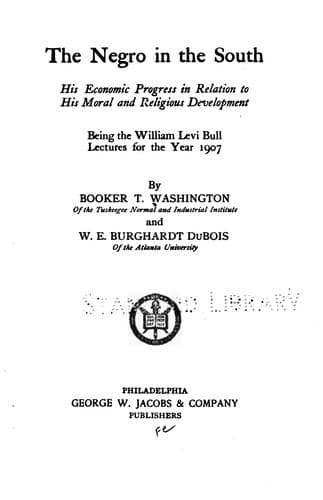
The Negro in the South: His Economic Progress in Relation to his Moral and Religious DevelopmentDu Bois, W. E. B. (William Edward Burghardt)
History
The Negro in the South: His Economic Progress in Relation to his Moral and Religious Development
Du Bois, W. E. B. (William Edward Burghardt)
African Americans -- Southern States
I should be sorry, I should be grieved more than I can say, to see
that which happened in the Southern Methodist Church and that which is
practically happening in the Presbyterian Church, and that which will
come in other sects--namely, a segregation of Negro Christians, come
to be true among Episcopalians. It would be a sign of Christian
disunity far more distressing than sectarianism. I should therefore
deplore it; and yet I am also free to say that unless this church is
prepared to treat its Negro members with exactly the same
consideration that other members receive, with the same brotherhood
and fellowship, the same encouragement to aspiration, the same
privileges, similarly trained priests and similar preferment for them,
then I should a great deal rather see them set aside than to see a
continuation of present injustice. All I ask is that when you do this
you do it with an open and honest statement of the real reasons and
not with statements veiled by any hypocritical excuses.
I am therefore above all desirous that the younger men and women who
are to-day taking up the leadership of this great group of men, who
wish the world better and work toward that end, should begin to see
the real significance of this step and of the great problem behind it.
It is not a problem simply of the South, not a problem simply of this
country, it is a problem of the world.
As I have said elsewhere: "Most men are colored. A belief in humanity
is above all a belief in colored men." If you cannot get on with
colored men in America you cannot get on with the modern world; and if
you cannot work with the humanity of this world how shall your souls
ever tune with the myriad sided souls of worlds to come?
It may be that the price of the black man's survival in America and in
the modern world, will be a long and shameful night of subjection to
caste and segregation. If so, he will pay it, doggedly, silently,
unfalteringly, for the sake of human liberty and the souls of his
children's children. But as he stoops he will remember the indignation
of that Jesus who cried, yonder behind heaving seas and years: "Woe
unto you scribes and Pharisees, hypocrites, that strain out a gnat and
swallow a camel,"--as if God cared a whit whether His Sons are born of
maid, wife or widow so long as His church sits deaf to His own
calling:
"Ho! every one that thirsteth, come ye to the waters and he that hath
no money; come ye, buy and eat; yea, come, buy wine and milk without
money and without price!"
FOOTNOTES:
[1] Grimke: "Right on the Scaffold."
[2] "The Negro Church," Atlanta University Publications, No. 8.
* * * * *
NOTES
TO CHAPTERS III AND IV
* * * * *
NOTES TO CHAPTER III
NOTE 1
Public-domain text, read in full here on John Shaqi.
Reviews
Reviews
No reviews yet
Be the first to share your thoughts on this work.
Elsewhere in the archive
Join the Discussion
Join the discussion
Sign in to leave a comment or review.
Sign InorCreate an account