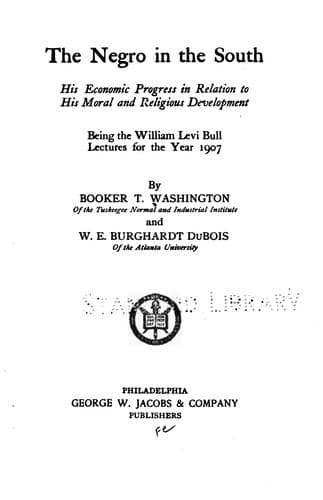
The Negro in the South: His Economic Progress in Relation to his Moral and Religious DevelopmentDu Bois, W. E. B. (William Edward Burghardt)
History
The Negro in the South: His Economic Progress in Relation to his Moral and Religious Development
Du Bois, W. E. B. (William Edward Burghardt)
African Americans -- Southern States
"The history of slavery and the slave trade after 1820 must be read in
the light of the industrial revolution through which the civilized
world passed in the first half of the nineteenth century. Between the
years 1775 and 1825 occurred economic events and changes of the
highest importance and widest influence. Though all branches of the
industry felt the impulse of this new industrial life, yet, if we
consider single industries, cotton manufacture has, during the
nineteenth century, made the most magnificent and gigantic advances."
This fact is easily explained by the remarkable series of inventions
that revolutionized this industry between 1738 and 1830, including
Arkwright's, Watt's, Compton's, and Cartwright's epoch making
contrivances. The effect which these inventions had on the manufacture
of cotton goods is best illustrated by the fact that in England, the
chief cotton market of the world, the consumption of raw cotton rose
steadily from 13,000 bales in 1781, to 572,000 in 1820, to 871,000 in
1830, and to 3,366,000 in 1860. Very early, therefore, came the query
whence the supply of raw cotton was to come. Tentative experiments on
the rich, broad fields of the Southern United States, together with
the indispensable invention of Whitney's cotton gin, soon answered
this question. A new economic future was opened up to this land, and
immediately the whole South began to extend its cotton culture, and
more and more to throw its whole energy into this one staple.
Here it was that the fatal mistake of compromising with slavery in the
beginning, and of the policy of _laissez-faire_ pursued thereafter,
became painfully manifest; for, instead now of a healthy, normal,
economic development along proper industrial lines, we have the
abnormal and fatal rise of a slave-labor, large-farming system, which,
before it was realized, had so intertwined itself with and braced
itself upon the economic forces of an industrial age, that a vast and
terrible civil war was necessary to displace it. The tendencies to a
patriarchal serfdom, recognized in the age of Washington and
Jefferson, began slowly but surely to disappear; and in the second
quarter of the century Southern slavery was irresistibly changing from
a family institution to an industrial system.
DuBois, "Suppression of the Slave Trade," p. 151.
A list of the chief inventions most graphically illustrates the
above:--
1738, John Jay, fly shuttle.
John Wyatt, spinning by rollers.
1748, Lewis Paul, carding machine.
1760, Robert Kay, drop box.
1769, Richard Arkwright, water-frame and throstle.
James Watt, steam-engine.
1772, James Lees, improvements on carding-machine.
1775, Richard Arkwright, series of combinations.
1779, Samuel Compton, mule.
1785, Edmund Cartwright, power-loom.
1803-4, Radcliffe and Johnson, dressing-machine.
1817, Roberts, fly-frame.
1818, William Eaton, self-acting frame.
1825-30, Roberts, improvements on mule.
Public-domain text, read in full here on John Shaqi.
Reviews
Reviews
No reviews yet
Be the first to share your thoughts on this work.
Elsewhere in the archive
Join the Discussion
Join the discussion
Sign in to leave a comment or review.
Sign InorCreate an account