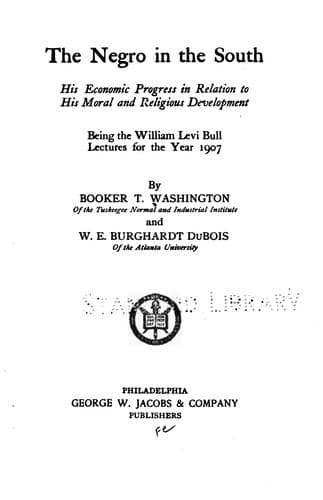
The Negro in the South: His Economic Progress in Relation to his Moral and Religious DevelopmentDu Bois, W. E. B. (William Edward Burghardt)
History
The Negro in the South: His Economic Progress in Relation to his Moral and Religious Development
Du Bois, W. E. B. (William Edward Burghardt)
African Americans -- Southern States
"The Journals of Virginia will verify the contention, that during the
'before the war' period, while the bishops and a large number of the
clergy were always interested in the religious training of the slaves,
yet as a matter of fact there was general apathy and indifference upon
the part of the laity with respect to this matter.
"At various intervals resolutions were presented in the Annual
Conventions with the avowed purpose of stimulating an interest in the
religious welfare of the slaves. But despite all these efforts the
Journals fail to record any great achievements along that line.... So
faithful had been the work under such conditions that as late as 1879
there were less than 200 colored communicants reported in the whole
state of Virginia." (_Church Advocate._)
NOTE 22
Charles C. Jones: "The Religious Instruction of the Negroes in the
United States," Savannah, 1842. Cf. Atlanta University Publication,
No. 8, passim.
NOTE 23
Cf. Hart, _supra._ Note too the decrease in the proportion of free
Negroes.
NOTE 24
Note Dr. Cartwright's articles; DeBow's "Review," Vol. II, pp. 29,
184, 331 and 504. Cf. Fitzhugh, "Cannibals All."
NOTE 25
Cf. Weeks, "Southern Quakers and Slavery," Balt. 1896; Ballagh,
"Slavery in Virginia."
NOTE 26
There has been in the North a generously conceived campaign in the
last ten years to emphasize the good in the South and minimize the
evil. Consequently many people have come to believe that men like
Fleming and Murphy represent either the dominant Southern sentiment
or that of a strong minority. On the contrary the brave utterances of
such men represent a very small and very weak minority--a minority
which is growing very slowly and which can only hope for success by
means of moral support from the outside. Such moral support has not
been generally given; it is Tillman, Vardaman and Dixon who get the
largest hearing in the land and they represent the dominant public
opinion in the South. The mass of public opinion there while it
hesitates at the extreme brutality of these spokesmen is nearer to
them than to Bassett or Fleming or Alderman.
NOTE 27
Cf. "The Negro Church," Atlanta University Publication, No. 8. 212 pp.
1903.
NOTE 28
Twenty good references on the ethical and religious aspect of slavery
and the Negro problem are:
C.C. Jones, "The Religious Instruction of the Negroes in the United
States," Savannah, 1842. 277 pp. 12mo.
R.F. Campbell, "Some Aspects of the Race Problem in the South,"
Pamphlet, 1899. Asheville, N.C. 31 pp. 8vo.
R.L. Dabney, "Defence of Virginia, and Through Her of the South," New
York, 1867. 356 pp. 12mo.
Nehemiah Adams, "A South Side View of Slavery," Boston, 1854. viii,
7-214 pp. 16mo.
Richard Allen, First Bishop of the A.M.E. Church. "The life,
experience and gospel labors of the Rt. Rev. Richard Allen." Written
by himself. Phila., 1793. 69 pp. 8vo.
Matthew Anderson, "Presbyterianism and Its Relation to the Negro,"
Phila., 1897.
Public-domain text, read in full here on John Shaqi.
Reviews
Reviews
No reviews yet
Be the first to share your thoughts on this work.
Elsewhere in the archive
Join the Discussion
Join the discussion
Sign in to leave a comment or review.
Sign InorCreate an account