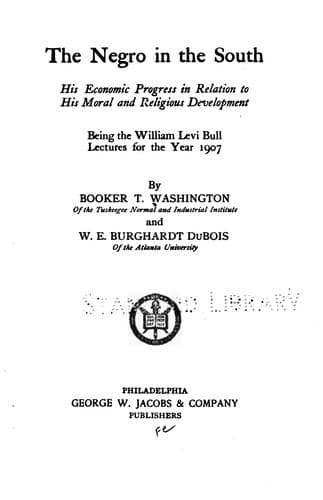
The Negro in the South: His Economic Progress in Relation to his Moral and Religious DevelopmentDu Bois, W. E. B. (William Edward Burghardt)
History
The Negro in the South: His Economic Progress in Relation to his Moral and Religious Development
Du Bois, W. E. B. (William Edward Burghardt)
African Americans -- Southern States
No. 4, "The Negro in Business," 77 pp. 1899.
No. 7, "The Negro Artisan," 192 pp. 1902.
8. Bulletins of the United States Department of Labor.
Nos. 10, 14, 22, 32, 35, 37, 38, 48.
9. United States: Report of the Industrial Commission 1901-2, 19 vols.
10. Proceedings of the American Economic Association, 1906.
NOTES TO CHAPTER IV
NOTE 18
See Atlanta University Publications, No. 8, Section 4.
NOTE 19
"Baptism doth not alter the condition of the person as to his bondage
or freedom, in order that diverse masters freed from this doubt may
more carefully endeavor the propagation of Christianity." (Williams I,
139.)
NOTE 20
Cf. Dr. Albert Bushnell Hart, "The Realities of Negro Suffrage,"
Proceedings of the American Political Science Association, Vol. II,
1905.
NOTE 21
The Church of England through the "Society for the Propagation of the
Gospel" (incorporated 1701) sent several missionaries who worked
chiefly in the North. The history of the society goes on to say: "It
is a matter of commendation to the clergy that they have done thus
much in so great and difficult a work. But, alas! what is the
instruction of a few hundreds in several years with respect to the
many thousands uninstructed, unconverted, living, dying, utter pagans.
It must be confessed what hath been done is as nothing with regard to
what a true Christian would hope to see effected." After stating
several difficulties in respect to the religious instruction of the
Negroes, it is said: "But the greatest obstruction is the masters
themselves do not consider enough the obligation which lies upon them
to have their slaves instructed." The work of this society in America
ceased in 1783. The Methodists report the following members:
1786 1,890
1790 11,682
1791 12,884
1796 12,215
Nearly all were in the North and the border states. Georgia had only
148. The Baptists had 18,000 Negro members in 1793. As to the
Episcopalians, the single state of Virginia where more was done than
elsewhere will illustrate the result:
"The Church Commission for Work among the Colored People at a late
meeting decided to request the various rectors of parishes throughout
the South to institute Sunday-schools and special services for the
colored population 'such as were frequently found in the South before
the war.' The commission hope for 'real advance' among the colored
people in so doing. We do not agree with the commission with respect
to either the wisdom or the efficiency of the plan suggested. In the
first place, this 'before the war' plan was a complete failure so far
as church extension was concerned, in the past when white churchmen
had complete bodily control of their slaves....
Public-domain text, read in full here on John Shaqi.
Reviews
Reviews
No reviews yet
Be the first to share your thoughts on this work.
Elsewhere in the archive
Join the Discussion
Join the discussion
Sign in to leave a comment or review.
Sign InorCreate an account