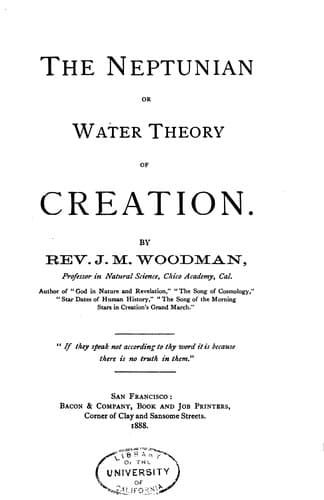
The Neptunian, or Water Theory of CreationWoodman, J. M.
Religion
The Neptunian, or Water Theory of Creation
Woodman, J. M.
Bible and science; Creation; Religion and science
6. A vast field of hydrogen united with its equivalent of oxygen; and,
in super-heated steam, evolved out into space, and took shape as a
globe. These divisions antedate geologic time. Geology must begin with
sedimentary rock. The globe of steam must liquify and pass back to the
ring, and through it toward the sun. In doing so, it took an atmosphere
with it that shows the source of all our rock. When taking its true
orbit about the sun, it was a vast globe of cold water, holding, by
gravitation, a dense atmosphere in its embrace, rich in material for
submarine rock. For a while the deposits were very rapid, and a great
quantity of pulp of rock was formed, before any hardening took place.
This accounts for the unstratified condition of granite. All the first
rocks would be submarine, hidden deep in the sea. Nearly eighty miles
depth of deposits took place before dry land could appear.
7. Contrasts marked the beginning and close of the first two divisions.
If we follow this order in this third division, we must wait until the
Devonian forests showed the renewed touch of the creative hand, giving
life in contrast to inorganic matter, with which the globe started into
form, and took its position as a planet of our system. Such is the
Neptunian theory in part, touching first causes in cosmology.
Section 3.
The well established Fact of Science look toward, and defend this
Theory.
1. In the relative quantities of sedimentary and lava rock. By far the
greater portion of rock of all lands is sedimentary. Lava is the
exception. If the source of supply is an internal sea, 7,880 miles in
diameter, the reverse of this would most likely be true.
2. In the relative order of the two kinds of rock. Except in very
restricted locations, sedimentary rock is at the bottom, in the middle,
and at the top of the earth’s crust. Lava has never been found as an
integral part of the supposed bottom rock.
3. The constituents of all rock indicate the water theory. All rock is
known to be a combination of gases. The coal is admitted to have been
gathered from the air, through the agency of vegetation. There are three
ways gases may be combined into rock:
(1.) Through the agency of water alone. Such was the primitive granite;
and such are the modern stalactites.
(2.) Through the agency of diatoms living in the water. These creatures
are absorbents. They absorb the minerals of the water, and form stone.
Such are lime, chalk and coral.
(3.) They may be absorbed into vegetation, and then hidden away in the
waters, until changed into coal.
(4.) Sandstone and conglomerate are formed from eroded material of other
rocks.
(5.) The melting of sedimentary rock in proximity to burning beds of
coal has formed the lava.
Public-domain text, read in full here on John Shaqi.
Reviews
Reviews
No reviews yet
Be the first to share your thoughts on this work.
Join the Discussion
Join the discussion
Sign in to leave a comment or review.
Sign InorCreate an account