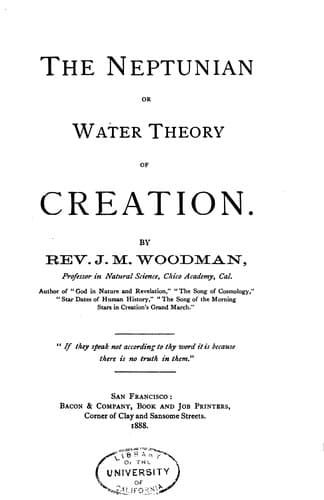
The Neptunian, or Water Theory of CreationWoodman, J. M.
Religion
The Neptunian, or Water Theory of Creation
Woodman, J. M.
Bible and science; Creation; Religion and science
16. Destruction and death say, “We have heard the fame thereof with our
ears. God understandeth the way thereof, and he knoweth the place
thereof; for he looketh to the ends of the earth, and seeth under the
whole heavens, to make the weight of the winds, and he weigheth the
waters by measure. When he made a decree for the rain, and a way for the
lightning of the thunder; then did he see it and declare it.” But how
shall man gain this true wisdom of causes? “He that cometh to God must
believe that he is, and that he is a rewarder of them that diligently
seek him.” It is the voice of the Saviour, he who “walked in the
garden.” Men must be drawn toward God before they can see him in his
word. “And unto man he said, Behold the fear of the Lord, that is
wisdom; and to depart from evil is understanding.” It cannot be doubted
that more reverence for God, and less egotistical trust in self, would
greatly aid the wisest thinker of the present day. We have had
altogether too much of that feigned or real pity for the Bible, as
unfortunate in its allusions to science, deserving to be ranked with the
superstitions of the untutored masses of the unlettered ages. It is true
that prophetic allusions to scientific subjects are usually poetic, but
none the less specific and definite for this. These allusions embody a
true objective view, leaving to science the task to subjectively work
out the true condition of things presenting such phenomena. Thus
prophecy poetized upon the “Place for light, and the home and house for
darkness; and the path leading to the bounds between them.”
Scientifically explained, one pole of the Earth must have pointed
steadily to the sun, leaving half the globe in perpetual darkness.
17. Joshua is said to have commanded the sun and the moon to stand
still, and they obeyed him. Subjectively rendered the sun went not down,
during one night, which could have been objectively accomplished by a
mirage. As this would answer the purpose for which the phenomena is
reported, it is highly probable that this is all that is meant. Again,
God made a firmament. But firmaments called heaven are not things made.
Subjectively rendered, he made a globe, from which the visible expanse
is seen. These figures of speech, and especially the one called
metonymy, run all through prophetic sayings. The heart’s willingness to
accept the truth is often necessary to the intellect’s perceiving it.
18. The Reformation has made some considerable progress, and Job’s three
mistaken friends begin to see their errors, and acknowledge themselves
silenced. Job’s renewed ability to speak, and the readiness with which
he handles the subject of each passing event, shows that the darkness is
passing away, and the teachings of these dismal ages are being
counteracted.
Public-domain text, read in full here on John Shaqi.
Reviews
Reviews
No reviews yet
Be the first to share your thoughts on this work.
Join the Discussion
Join the discussion
Sign in to leave a comment or review.
Sign InorCreate an account