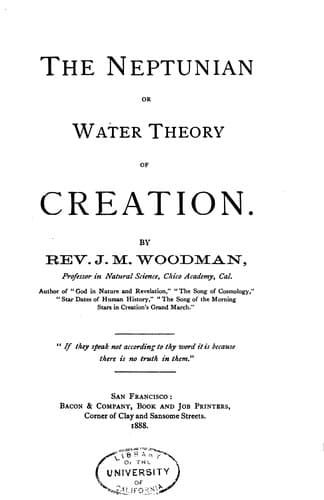
The Neptunian, or Water Theory of CreationWoodman, J. M.
Religion
The Neptunian, or Water Theory of Creation
Woodman, J. M.
Bible and science; Creation; Religion and science
23. The great under-waters were once imprisoned as though shut behind
doors. “Or who shut up the sea with doors when it brake forth as if it
had issued out of the womb?” Rotundity of the Earth is here given with
the inside water. He saw the young Earth first “clothed in a garment of
clouds,” and “thick darkness a swaddling band about it.” He saw the
“foundations of the earth breaking up,” as the flood in Noah’s day
poured in over the earth. “And brake up the decreed place for it,” and
set new “bars and doors.” A change of polarity, and when it took place,
is seen. “Hast thou commanded the morning since thy days, and caused the
day-spring to know his place, that it might take hold of the ends of the
earth, that the wicked might be shaken out of it?” When have the wicked
been shaken out of it, but when “all the fountains of the great deep
were broken up?” The finishing touch is added to the Copernican system.
“It is turned as clay to the seal.” Allusion is made to the clay on the
potter’s wheel rotating to a fixed seal shaping the same. In contrast to
its present motion, he saw a former condition with pole pointing to the
sun. This was a motion that never exchanged the darkness for light, nor
light for darkness, but both remained stationary. “Where is the way
where light dwelleth? and as for darkness, where is the place thereof,
that thou shouldst take it to the bound thereof, and that thou shouldst
know the paths to the house thereof?” He saw the contrasted appearance
of the former earth to her present contour. “The waters are hid as with
a stone.” Altogether, the land hemisphere covered the under-waters; “and
the face of the deep is frozen.” The face of the deep in the southern
hemisphere of the ancient earth was locked in darkness and perpetual
ice. He had asked the question, “Out of whose womb came the ice?” Where
was it born? This is one of the most perplexing questions in science.
Public-domain text, read in full here on John Shaqi.
Reviews
Reviews
No reviews yet
Be the first to share your thoughts on this work.
Join the Discussion
Join the discussion
Sign in to leave a comment or review.
Sign InorCreate an account