The Neptunian, or Water Theory of Creation — John Shaqi
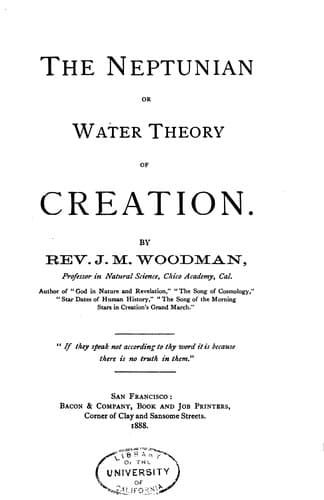
The Neptunian, or Water Theory of CreationWoodman, J. M.
Religion
The Neptunian, or Water Theory of Creation
Woodman, J. M.
Bible and science; Creation; Religion and science
6. A spark would unite a field of Hydrogen and Oxygen, and cause a
division in the ring, as a new element much lighter, formed in space in
the condition of superheated steam. Its lightness would cause it to
evolve outside the ring, and take the form of a globe. “And God made the
firmament,” and he called it “heaven,” which is the visible expanse of a
half circle or sphere above our heads; “and he divided the waters which
were under the firmament, (the first, which was a tangible circle) from
the waters which were above the firmament.” The Earth is in form, but
has, as yet, but two gases; and these unite in steam. The second day of
creation ends without a “footprint” for the unassisted geologists to
trace. Well may Job refer man to the voice of the Lord for the wisdom of
first cause and the early changes of matter. This newly formed
firmament, or visible expanse, which, by figure of metonymy means a
newly formed globe, differs materially from the ring substance of the
sun, which gave rise to the term firmament. This second firmament is not
made of tangible gases, nor is its appearance to dwellers on the earth
continuous. Hence, the making of this firmament is the objective
description of the formation of our Earth as a globe. With a world of
steam in globe form, the second age or day of creation ended. The
matter, that gathered would constitute Earth, while floating in chaos
was called evening. When the globe took its form, though only a world of
steam, it was called morning. “And the evening and the morning were the
second day.” No measurement of twenty-four hour days had commenced yet.
Having followed our globe out into space, the prophet now confines his
observations to this single planet. He beholds the outside liquifying,
and he follows it into its present orbit. He made no mention of the
“swaddling band,” it took out of the ring as it passed back toward the
sun. This had been well noticed by Job, as well as the manner of the
first deposits. But he noticed the appearance of dry land; and the
introduction of terrestrial vegetation, and described them as cryptogam
“having the seed in itself.” He had followed the gathering together of
the waters as a grand sea, and the inorganic deposits as a long evening;
and now, to bring out a grand contrast, as morning, he waited until the
forests sung the praises of God’s creative hand in bestowing life. “And
the evening and the morning were the third day.” But this vegetation
grows in the veiled light, much as the gray of twilight. This twilight
is the evening of the fourth day. Contrasting with it is pure sunlight.
The Carboniferous age of the world cleared the air of these deadly
gases, and let in the sunshine upon the earth. This was morning. In
noticing this, he is reminded that this globe is occupying his entire
attention; and yet God made all the planets and suns of the heavens. So
the source of light is again noticed and its proper name given to it,
Public-domain text, read in full here on John Shaqi.
Reviews
Reviews
No reviews yet
Be the first to share your thoughts on this work.
Join the Discussion
Join the discussion
Sign in to leave a comment or review.
Sign InorCreate an account