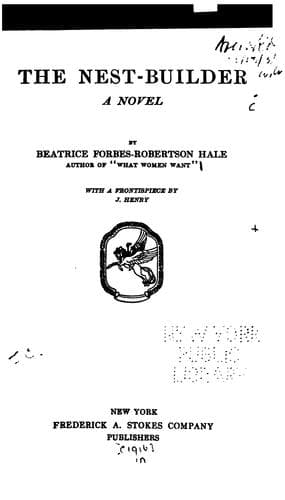
The Nest Builder: A NovelHale, Beatrice Forbes-Robertson
General
The Nest Builder: A Novel
Hale, Beatrice Forbes-Robertson
Marriage -- Fiction
Stefan Byrd's table companions were guilty in his eyes of the one
unforgivable sin--they were ugly. Ugly alike in feature, dress, and
bearing, they had for him absolutely no excuse for existence. He felt no
bond of common humanity with them. In his lexicon what was not beautiful
was not human, and he recognized no more obligation of good fellowship
toward them than he would have done toward a company of ground-hogs.
He lay back, one fine and nervous hand across his eyes, trying to
obliterate the image of the saloon and all its inmates by conjuring up a
vision of the world he had left, the winsome young cosmopolitan Paris of
the art student. The streets, the cafés, the studios; his few men, his
many women, friends--Adolph Jensen, the kindly Swede who loved him;
Louise, Nanette, the little Polish Yanina, who had said they loved him;
the slanting-glanced Turkish students, the grave Syrians, the democratic
un-British Londoners--the smell, the glamour of Paris, returned to him
with the nostalgia of despair.
These he had left. To what did he go?
II
In his shivering, creaking little cabin, suspended, as it were, by the
uncertain waters between two lives, Byrd forced himself to remember
the America he had known before his Paris days. He recalled his
birthplace--a village in upper Michigan--and his mental eyes bored
across the pictures that came with the running speed of a cinematograph
to his memory.
The place was a village, but it called itself a city. The last he had
seen of it was the “depot,” a wooden shed surrounded by a waste of
rutted snow, and backed by grimy coal yards. He could see the broken
shades of the town's one hotel, which faced the tracks, drooping across
their dirty windows, and the lopsided sign which proclaimed from the
porch roof in faded gilt on black the name of “C. E. Trench, Prop.” He
could see the swing-doors of the bar, and hear the click of balls from
the poolroom advertising the second of the town's distractions. He could
smell the composite odor of varnish, stale air, and boots, which made
the overheated station waiting-room hideous. Heavy farmers in ear-mitts,
peaked caps, and fur collars spat upon the hissing stove round which
their great hide boots sprawled. They were his last memory of his fellow
citizens.
Public-domain text, read in full here on John Shaqi.
Reviews
Reviews
No reviews yet
Be the first to share your thoughts on this work.
Join the Discussion
Join the discussion
Sign in to leave a comment or review.
Sign InorCreate an account