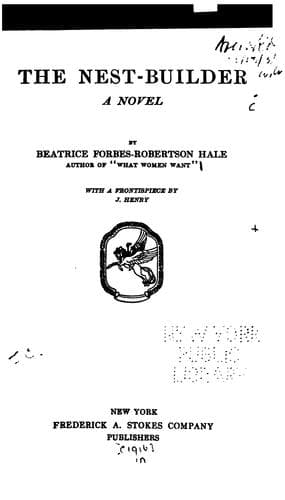
The Nest Builder: A NovelHale, Beatrice Forbes-Robertson
General
The Nest Builder: A Novel
Hale, Beatrice Forbes-Robertson
Marriage -- Fiction
The weather had turned cool, and Mr. Corriani brought them up their
first scuttle of coal. They were glad to drink their morning coffee and
eat their lunch before the fire, and Mary's little sable neck-piece,
relic of former opulence, appeared in the evenings when they sought
their dinner. This they took in restaurants near by--quaint basements,
or back parlors of once fine houses, where they were served nutritious
meals on bare boards, in china half an inch thick. Autumn, New York's
most beautiful season, was in the air with its heart-lightening tang;
energy seemed to flow into them as they breathed. They took long walks
in the afternoons to the Park, which Stefan voted hopelessly banal; to
the Metropolitan Museum, where they paid homage to the Sorollas and the
Rodins; to the Battery, the docks, and the whole downtown district. This
they found oppressive at first, till they saw it after dark from a ferry
boat, when Stefan became fired by the towerlike skyscrapers sketched in
patterns of light against the void.
Immediately he developed a cult for these buildings. “America's one
creation,” he called them, “monstrous, rooted repellently in the earth's
bowels, growing rank like weeds, but art for all that.” He made several
sketches of them, in which the buildings seemed to sway in a drunken
abandonment of power. “Wicked things,” he named them, and saw them
menacing but fascinating, titanic engines that would overwhelm their
makers. He and Mary had quite an argument about this, for she thought
the skyscrapers beautiful.
“They reach sunward, Stefan, they do not menace, they aspire,” she
objected.
“The aspiration is yours, Goddess. They are only fit symbols of a
super-materialism. Their strength is evil, but it lures.”
He was delighted with his drawings. Mary, who was beginning to develop
civic pride, told him they were goblinesque.
“Clever girl, that's why I like them,” he replied.
Late in October Stefan sold his pastoral, though only for seventy-five
dollars. This disappointed him greatly. He was anxious to repay his
debt to Adolph, but would not accept the loan of it from his wife. Mary
renewed her determination to be helpful, and sent one of her old stories
to a magazine, but without success. She had no one to advise her as
to likely markets, and posted her manuscript to two more unsuitable
publications, receiving it back with a printed rejection slip.
Her fourth attempt, however, was rewarded by a note from the editor
which gave her much encouragement. Children's stories, he explained,
were outside the scope of his magazine, but he thought highly of Mrs.
Byrd's manuscript, and advised her to submit it to one of the women's
papers--he named several--where it might be acceptable. Mary was
delighted by this note, and read it to Stefan.
“Splendid!” he cried, “I had no idea you had brought any stories over
with you. Guarded oracle!” he added, teasingly.
“Oracles don't tell secrets unless they are asked,” she rejoined.
Public-domain text, read in full here on John Shaqi.
Reviews
Reviews
No reviews yet
Be the first to share your thoughts on this work.
Join the Discussion
Join the discussion
Sign in to leave a comment or review.
Sign InorCreate an account