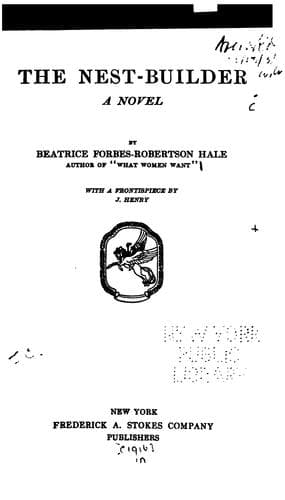
The Nest Builder: A NovelHale, Beatrice Forbes-Robertson
General
The Nest Builder: A Novel
Hale, Beatrice Forbes-Robertson
Marriage -- Fiction
On her table his mother had a little globe which revolved above a
brass base. Because of this he knew the relative position of two
places--America and Bohemia. Of this country he thought his mother was
unwilling to speak, but its name fell from her lips with sighs, with--as
it now seemed to him--a wild longing. Knowing nothing of it, he had
pictured it a paradise, a land of roses. He seemed to have no knowledge
of why she had left it; but years later his father spoke of finding her
in Boston in the days when he preached there, penniless, searching for
work as a teacher of singing. How she became jettisoned in that--to
her--cold and inhospitable port, Stefan did not know, nor how soon
after their marriage the two moved to the still more alien peninsula of
Michigan.
Into his memories of the room where they painted a shadow constantly
intruded, chilling them, such a shadow, deep and cold, as is cast by an
iceberg. The door would open, and his father's face, high and white with
ice-blue eyes, would hang above them. Instantly, the man remembered, the
boy would cower like a fledgling beneath the sparrow-hawk, but with as
much distaste as fear in his cringing. The words that followed always
seemed the same--he could reconstruct the scene clearly, but whether it
had occurred once or many times he could not tell. His father's voice
would snap across the silence like a high, tight-drawn string--
“Still wasting time? Have you nothing better to do? Where is your
sewing? And the boy--why is he not outside playing?”
“This helps me, Henry,” his mother answered, hesitating and low. “Surely
it does no harm. I cannot sew all the time.”
“It is a childish and vain occupation, however, and I disapprove of
the boy being encouraged in it. This of course you know perfectly well.
Under ordinary circumstances I should absolutely forbid it; as it is, I
condemn it.”
“Henry,” his mother's voice trembled, “don't ask me to give up his
companionship. It is too cold for me to be outdoors, and perhaps after
the spring I might not be with him.”
This sentence terrified Stefan, who did not know the meaning of it. He
was glad, for once, of his father's ridicule.
“That is perfectly absurd, the shallow excuse women always make their
husbands for self-indulgence,” said the man, turning to go. “You are a
healthy woman, and would be more so but for idleness.”
His wife called him back, pleadingly. “Please don't be angry with me,
I'm doing the best I can, Henry--the very best I can.” There was a sweet
foreign blur in her speech, Stefan remembered.
His father paused at the door. “I have shown you your duty, my dear. I
am a minister, and you cannot expect me to condone in my wife habits of
frivolity and idleness which I should be the first to reprimand in my
flock. I expect you to set an example.”
“Oh,” the woman wailed, “when you married me you loved me as I was--”
Public-domain text, read in full here on John Shaqi.
Reviews
Reviews
No reviews yet
Be the first to share your thoughts on this work.
Join the Discussion
Join the discussion
Sign in to leave a comment or review.
Sign InorCreate an account