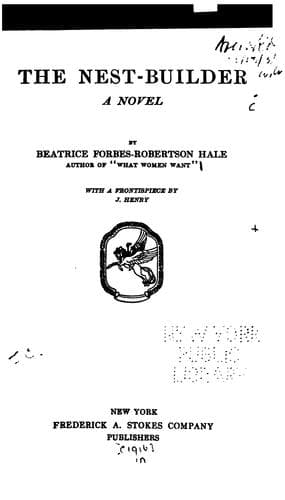
The Nest Builder: A NovelHale, Beatrice Forbes-Robertson
General
The Nest Builder: A Novel
Hale, Beatrice Forbes-Robertson
Marriage -- Fiction
Try as she would, Mary failed to shake her friends' estimate of her
share in the family success. It became the fashion to regard her as
a muse, and she, who had felt oppressed by Stefan's lover-like
deification, now found her friends, too, conspiring to place her on a
pedestal. Essentially simple and modest, she suffered real discomfort
from the cult of adoration that surrounded her. Coming from a British
community which she felt had underestimated her, she now found herself
made too much of. A smaller woman would have grown vain amid so much
admiration; Mary only became inwardly more humble, while outwardly
carrying her honors with laughing deprecation.
For some time after the night of Constance's reception, Stefan had shown
every evidence of contentment, but as the winter dragged into a cold
and slushy March he began to have recurrent moods of his restless
irritability. By this time Mary was moving heavily; she could no longer
keep brisk pace with him in his tramps up the Avenue, but walked more
slowly and for shorter distances. She no longer sprang swiftly from
her chair or ran to fetch him a needed tool; her every movement was
matronly. But she was so well, so entirely normal, as practically to be
unconscious of a change to which her husband was increasingly alive.
Another source of Stefan's dissatisfaction lay in the progress of his
Demeter. This picture showed the Goddess enthroned under the shade of a
tree, beyond which spread harvest fields in brilliant sunlight. At her
feet a naked boy, brown from the sun, played with a pile of red and
golden fruits. In the distance maids and youths were dancing. The
Goddess sat back drowsily, her eyelids drooping, her hands and arms
relaxed over her chair. She had called all this richness into being, and
now in the heat of the day she rested, brooding over the fecund earth.
So far, the composition was masterly, but the tones lacked the necessary
depth; they were vivid where they should have been warm, and he felt the
deficiency without yet having been able to remedy it.
“Oh, damn!” said Stefan one morning, throwing down his brush. “This
picture is architectural, absolutely. What possessed me to try such a
conception? I can only do movement. I can't be static. Earth! I don't
understand it--everything good I've done has been made of air and fire,
or water.” He turned an irritable face to Mary.
“Why did you encourage me in this?”
She looked up in frank astonishment, about to reply, but he forestalled
her.
“Oh, yes, I know I was pleased with the idea--it isn't your fault, of
course, and yet--Oh, what's the use!” He slapped down his pallette and
made for the door. “I'm off to get some air,” he called.
Mary felt hurt and uneasy. The nameless doubts of the autumn again
assailed her. What would be the end, she wondered, of her great
adventure? The distant prospect vaguely troubled her, but she turned
easily from it to the immediate future, which held a blaze of joy
sufficient to obliterate all else.
Public-domain text, read in full here on John Shaqi.
Reviews
Reviews
No reviews yet
Be the first to share your thoughts on this work.
Elsewhere in the archive
Join the Discussion
Join the discussion
Sign in to leave a comment or review.
Sign InorCreate an account