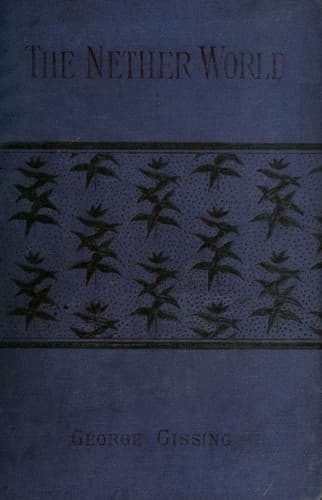
English fiction -- 19th century; London (England) -- Fiction; Poor -- Fiction; Poverty -- Fiction
‘You may be very sure I will do anything I can to be of use to you,’
Sidney replied, his thick voice contrasting so strongly with that which
had just failed into silence that he coughed and lowered his tone after
the first few syllables. He meant to express himself without a hint of
emotion, but it was beyond his power. The words in which she spoke of
her calamity seemed so pathetically simple that they went to his heart.
Clara had recovered all her faculties. The fever and the anguish and
the dread were no whit diminished, but they helped instead of checking
her. An actress improvising her part, she regulated every tone with
perfect skill, with inspiration; the very attitude in which she seated
herself was a triumph of the artist’s felicity.
‘I just said a word or two in my note,’ she resumed, ‘that you might
have replied if you thought nothing could be gained by my speaking to
you. I couldn’t explain fully what I had in mind. I don’t know that
I’ve anything very clear to say even now, but—you know what has
happened to me; you know that I have nothing to look forward to, that I
can only hope to keep from being a burden to my father. I am getting
stronger; it’s time I tried to find something to do. But I—’
Her voice failed again. Sidney gazed at her, and saw the dull lamplight
just glisten on her hair. She was bending forward a little, her hands
joined and resting on her knee.
‘Have you thought what kind of—of work would be best for you?’ Sidney
asked. The ‘work’ stuck in his throat, and he seemed to himself brutal
in his way of uttering it. But he was glad when he had put the question
thus directly; one at least of his resolves was carried out.
‘I know I’ve no right to choose, when there’s necessity,’ she answered,
in a very low tone. ‘Most women would naturally think of needlework;
but I know so little of it; I scarcely ever did any. If I could—I might
perhaps do that at home, and I feel—if I could only avoid—if I could
only be spared going among strangers—’
Her faltering voice sank lower and lower; she seemed as if she would
have hidden her face even under its veil.
‘I feel sure you will have no difficulty,’ Sidney hastened to reply,
his own voice unsteady. ‘Certainly you can get work at home. Why do you
trouble yourself with the thought of going among strangers? There’ll
never be the least need for that; I’m sure there won’t. Haven’t you
spoken about it to your father?’
‘Yes. But he is so kind to me that he won’t hear of work at all. It was
partly on that account that I took the step of appealing to you. He
doesn’t know who I am meeting here to-night. Would you—I don’t know
whether I ought to ask—but perhaps if you spoke to him in a day or two,
and made him understand how strong my wish is. He dreads lest we should
be parted, but I hope I shall never have to leave him. And then, of
course, father is not very well able to advise me—about work, I mean.
You have more experience. I am so helpless. Oh, if you knew how
helpless I feel!’
Public-domain text, read in full here on John Shaqi.
Reviews
Reviews
No reviews yet
Be the first to share your thoughts on this work.
Elsewhere in the archive
Join the Discussion
Join the discussion
Sign in to leave a comment or review.
Sign InorCreate an account