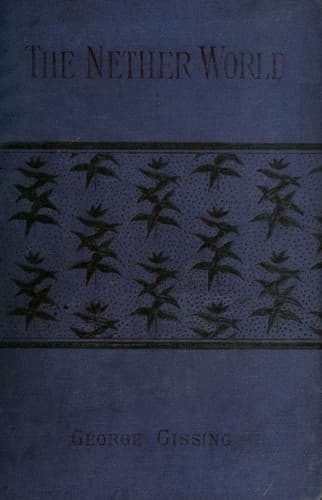
English fiction -- 19th century; London (England) -- Fiction; Poor -- Fiction; Poverty -- Fiction
‘If you really wish it, I will talk with your father—’
‘Indeed, I do wish it. My coming to live here has made everything so
uncomfortable for him and the children. Even his friends can’t visit
him as they would; I feel that, though he won’t admit that it’s made
any difference.’
Sidney looked to the ground. He heard her voice falter as it continued.
‘If I’m to live here still, it mustn’t be at the cost of all his
comfort. I keep almost always in the one room. I shouldn’t be in the
way if anyone came. I’ve been afraid, Mr. Kirkwood, that perhaps you
feared to come lest, whilst I was not very well, it might have been an
inconvenience to us. Please don’t think that. I shall never—see either
friends or strangers unless it is absolutely needful.’
There was silence.
‘You do feel much better, I hope?’ fell from Sidney’s lips.
‘Much stronger. It’s only my mind; everything is so dark to me. You
know how little patience I always had. It was enough if any one said,
‘You _must_ do this,’ or ‘You _must_ put up with that’—at once I
resisted. It was my nature; I couldn’t bear the feeling of control.
That’s what I’ve had to struggle with since I recovered from my
delirium at the hospital, and hadn’t even the hope of dying. Can you
put yourself in my place, and imagine what I have suffered?’
Sidney was silent. His own life had not been without its passionate
miseries, but the modulations of this voice which had no light of
countenance to aid it raised him above the plane of common experience
and made actual to him the feelings he knew only in romantic story. He
could not stir, lest the slightest sound should jar on her speaking.
His breath rose visibly upon the chill air, but the discomfort of the
room was as indifferent to him as to his companion. Clara rose, as if
impelled by mental anguish; she stretched out her hand to the
mantel-piece, and so stood, between him and the light, her admirable
figure designed on a glimmering background.
‘I know why you say nothing,’ she continued, abruptly but without
resentment. ‘You cannot use words of sympathy which would be anything
but formal, and you prefer to let me understand that. It is like you.
Oh, you mustn’t think I mean the phrase as a reproach. Anything but
that. I mean that you were always honest, and time hasn’t changed
you—in that.’ A slight, very slight, tremor on the close. ‘I’d rather
you behaved to me like your old self. A sham sympathy would drive me
mad.’
‘I said nothing,’ he replied, ‘only because words seemed meaningless.’
‘Not only that. You feel for me, I know, because you are not heartless;
but at the same time you obey your reason, which tells you that all I
suffer comes of my own self-will.’
‘I should like you to think better of me than that. I’m not one of
those people, I hope, who use every accident to point a moral, and
begin by inventing the moral to suit their own convictions. I know all
the details of your misfortune.’
Public-domain text, read in full here on John Shaqi.
Reviews
Reviews
No reviews yet
Be the first to share your thoughts on this work.
Elsewhere in the archive
Join the Discussion
Join the discussion
Sign in to leave a comment or review.
Sign InorCreate an account