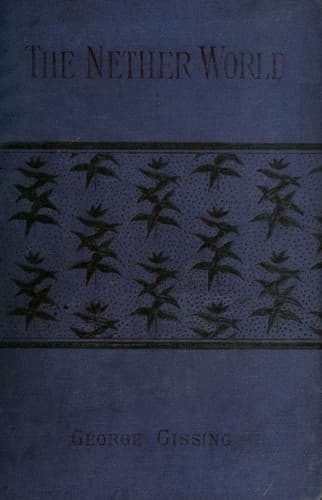
English fiction -- 19th century; London (England) -- Fiction; Poor -- Fiction; Poverty -- Fiction
Bessie busied herself affectionately in removing Jane’s hat and jacket,
then withdrew that father and child might converse in private. Joseph
looked at his daughter. His praise of her was not all mere affectation
of sentiment. He had spoken truly when he said to Scawthorne that, but
for Clem, he would ask nothing better than to settle down with this
gentle girl for his companion. Selfishness, for the most part, but
implying appreciation of her qualities. She did not love him, but he
was sincere enough with himself to admit that this was perfectly
natural. Had circumstances permitted, he would have tried hard to win
some affection from her. Poor little girl! How would it affect her when
she heard what he was going to say? He felt angry with Kirkwood; yes,
truly indignant—men are capable of greater inconsistencies than this.
She would not have cared much about the money had Kirkwood married her;
of that he felt sure. She had lost her lover; now he was going to
deprive her of her inheritance. Cruel! Yes; but he really felt so
well-disposed to her, so determined to make her a comfortable provision
for the future; and had the money been hers, impossible to have
regarded her thus. Joseph was thankful to the chance which, in making
him wealthy, had also enabled him to nourish such virtuous feeling.
How should he begin? He had a bright idea, an idea worthy of him.
Thrusting his hand into his pocket he brought out half-a-crown. Then:
‘Your humble friend’s in a sad condition, I’m afraid, Jane?’
‘She is, father.’
‘Suppose you give her this! Every little helps, you know.’
Jane received the coin and murmured thanks for his kindness, but could
not help betraying some surprise. Joseph was on the watch for this. It
gave him his exquisite opportunity.
‘You’re surprised at me offering you money, Jane? I believe your poor
grandfather led you to suppose that—that his will was made almost
entirely in your favour?’
Jane could not reply; she searched his face.
‘Would it disappoint you very much, my child,’ he continued,
sympathetically, ‘if it turned out that he had either altered his mind
or by some accident had neglected to make his will? I speak as your
father, Janey, and I think I have some knowledge of your character. I
think I know that you are as free from avarice as anyone could be.’
Was it true? he began to ask himself. Why, then, had her countenance
fallen? Why did such a look of deep distress pass over it?
‘The fact is, Janey,’ he continued, hardening himself a little as he
noted her expression, ‘your grandfather left no will. The result—the
legal result—of that is, that all his property becomes—ah—mine. He—in
fact he destroyed his will a very short time, comparatively speaking,
before he died, and he neglected to make another. Unfortunately, you
see, under these circumstances we can’t be sure what his wish was.’
She was deadly pale; there was anguish in the look with which she
regarded her father.
Public-domain text, read in full here on John Shaqi.
Reviews
Reviews
No reviews yet
Be the first to share your thoughts on this work.
Elsewhere in the archive
Join the Discussion
Join the discussion
Sign in to leave a comment or review.
Sign InorCreate an account