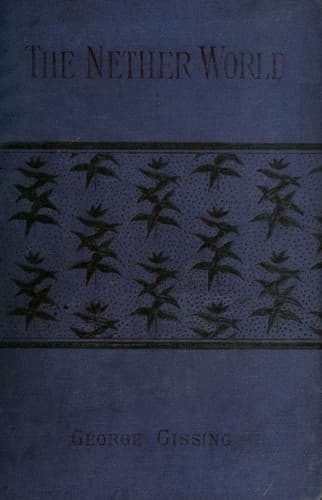
English fiction -- 19th century; London (England) -- Fiction; Poor -- Fiction; Poverty -- Fiction
‘I’m very sorry it pains you so, my dear,’ Joseph remarked, still more
coldly. ‘I didn’t think you were so taken up with the thought of money.
Really, Jane, a young girl at your time of life—’
‘Father, father, how can you think that? It wasn’t to be for myself; I
thought you knew; indeed you did know!’
‘But you looked so very strange, my dear. Evidently you felt—’
‘Yes—I feel it—I do feel it! But because it means that grandfather
couldn’t get back his trust in me. Oh, it is too hard! When did he
destroy his will? When, father?’
‘Ten days before his death.’
‘Yes; that was when it happened. You never heard; he promised to tell
nobody. I disappointed him. I showed myself very foolish and weak in—in
something that happened then. I made grandfather think that I was too
selfish to live as he hoped—that I couldn’t do what I’d undertaken.
That was why he destroyed his will. And I thought he had forgiven me! I
thought he trusted me again! O grandfather!’
Snowdon was astonished at the explanation of his own good luck, and yet
more at Jane’s display of feeling. So quiet, so reserved as he had
always known her, she seemed to have become another person. For some
moments he could only gaze at her in wonder. Never yet had he heard,
never again would he hear, the utterance of an emotion so profound and
so noble.
‘Jane—try and control yourself, my dear. Let’s talk it over, Jane.’
‘I feel as if it would break my heart. I thought I had that one thing
to comfort me. It’s like losing him again—losing his confidence. To
think I should have disappointed him in just what he hoped more than
anything!’
‘But you’re mistaken,’ Joseph exclaimed, a generous feeling for once
getting the better of prudence. ‘Listen, my dear, and I’ll explain to
you. I hadn’t finished when you interrupted me.’
She clasped her hands upon her lap and gazed at him in eager appeal.
‘Did he say anything to you, father?’
‘No—and you may be quite sure that if he _hasn’t_ trusted you, he
_would_ have said something. What’s more, on the very day before his
death he wrote a letter to Mr. Percival, to say that he wanted to make
his will again. He was going to do it on the Monday—there now. It was
only an accident; he hadn’t time to do what he wished.’
This was making a concession which he had expressly resolved to guard
against; but Joseph’s designs ripened, lost their crudity, as he saw
more and more of his daughter’s disposition. He was again grateful to
her; she had made things smoother than he could have hoped.
‘You really think, father, that he would have made the same will as
before?’
‘Not a doubt about it, my love; not a doubt of it. In fact—now let me
set your poor little mind at rest—only two days before his death—when
was it I saw him last? Friday? Thursday?—he said to me that he had a
higher opinion of you than ever. There now, Jane!’
She would have deemed it impossible for anyone to utter less than truth
in such connection as this. Her eyes gleamed with joy.
Public-domain text, read in full here on John Shaqi.
Reviews
Reviews
No reviews yet
Be the first to share your thoughts on this work.
Elsewhere in the archive
Join the Discussion
Join the discussion
Sign in to leave a comment or review.
Sign InorCreate an account