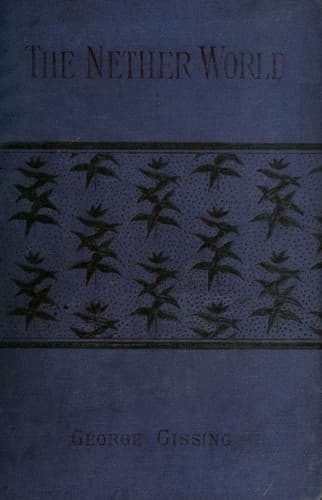
English fiction -- 19th century; London (England) -- Fiction; Poor -- Fiction; Poverty -- Fiction
She did her best to keep it out of her consciousness, and in truth had
so many other things to think about that it was seldom she really had
trouble with it. Life was not altogether easy; regular work was not
always to be kept; there was much need of planning and pinching, that
her independence might suffer no wound, Bessie Byass was always in arms
against that same independent spirit; she scoffed at it, assailed it
with treacherous blandishment, made direct attacks upon it.
‘I must live in my own way, Mrs. Byass. I don’t want to have to leave
you.’
And if ever life seemed a little too hard, if the image of the past
grew too mournfully persistent, she knew where to go for consolation.
Let us follow her, one Saturday afternoon early in the year.
In a poor street in Clerkenwell was a certain poor little shop—built
out as an afterthought from an irregular lump of houses; a shop with a
room behind it and a cellar below; no more. Here was sold second-hand
clothing, women’s and children’s. No name over the front, but
neighbours would have told you that it was kept by one Mrs. Todd, a
young widow with several children. Mrs. Todd, not long ago, used to
have only a stall in the street; but a lady named Miss Lant helped her
to start in a more regular way of business.
‘And does she carry it on quite by herself?’
No; with her lived another young woman, also a widow, who had one
child. Mrs. Hewett, her name. She did sewing in the room behind, or
attended to the shop when Mrs. Todd was away making purchases.
There Jane Snowdon entered. The clothing that hung in the window made
it very dark inside; she had to peer a little before she could
distinguish the person who sat behind the counter. ‘Is Pennyloaf in,
Mrs. Todd?’
‘Yes, Miss. Will you walk through?’
The room behind is lighted from the ceiling. It is heaped with the most
miscellaneous clothing. It contains two beds, some shelves with
crockery, a table, some chairs—but it would have taken you a long time
to note all these details, so huddled together was everything. Part of
the general huddling were five children, of various ages; and among
them, very busy, sat Pennyloaf.
‘Everything going on well?’ was Jane’s first question.
‘Yes, Miss.’
‘Then I know it isn’t. Whenever you call me “Miss,” there’s something
wrong; I’ve learnt that.’
Pennyloaf smiled, sadly but with affection in her eyes. ‘Well, I have
been a bit low, an’ that’s the truth. It takes me sometimes, you know.
I’ve been thinkin’, when I’d oughtn’t.’
‘Same with me, Pennyloaf. We can’t help thinking, can we? What a good
thing if we’d nothing more to think about than these children! Where’s
little Bob? Why, Bob, I thought you were old clothes; I did, really!
You may well laugh!’
The laughter was merry, and Jane encouraged it, inventing all sorts of
foolish jokes. ‘Pennyloaf, I wish you’d ask me to stay to tea.’
‘Then that I will, Miss Jane, an’ gladly. Would you like it soon?’
Public-domain text, read in full here on John Shaqi.
Reviews
Reviews
No reviews yet
Be the first to share your thoughts on this work.
Elsewhere in the archive
Join the Discussion
Join the discussion
Sign in to leave a comment or review.
Sign InorCreate an account