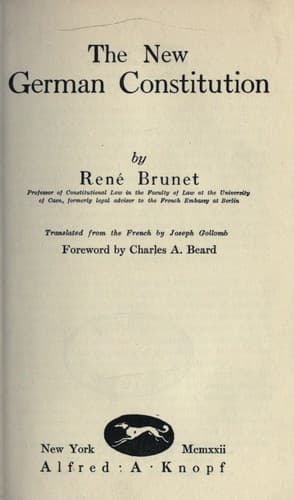
Germany -- Politics and government -- 1918-1933; Germany. Verfassung (1919)
Under the Empire, the Reichstag was at first elected for three years.
Since 1888 it has been elected for five years. Should this term be
retained?
On the Left the Independents considered that the motive which had
prompted the change in 1888, that is, the fear of too frequent elections,
did not deserve consideration. They held that it was necessary to give
the German people quickly the political education it lacks, and that
frequent elections are the best means to employ. They declared that in a
true democracy the people should be given the chance to make themselves
heard as often as possible.
The Right replied that in all parliaments the first year that follows
general elections is, so to say, lost because of the necessary labour
of preparation; and because the old and the new members must become
accustomed to working together before their efforts achieve appreciable
efficiency.
Preuss added that the question to find out was whether parliamentarism
was wanted or not. A parliament, said he, is inefficient to the extent
that the term for which it is elected is short. In America the House of
Representatives is, it is true, elected for two years, but it is not
the centre of power and of parliamentary authority. The Senate has more
authority than the House, and it is elected for six years. In addition
there is no dissolution of parliament possible in America. If a period of
two years is fixed and if in addition the right of dissolution admitted,
which is in itself already a remedy against too protracted a term,
the development of the parliamentary system would be rendered thereby
extremely difficult.
Finally on the third reading of a bill the Assembly arrived at a medium
term. The duration of power for members of the Reichstag was fixed at
four years.
4.--THE POWERS OF THE REICHSTAG.
The Reichstag is the principal holder of popular sovereignty; as such
it is the most important organ of the national representation. Its
activity is manifested under different forms and, compared to the old
Constitution, its limits have been greatly broadened. Although it is
above all a legislative organ, it exercises also an unceasing action on
the executive power.
I.--POWERS OF THE REICHSTAG AS PRINCIPAL HOLDER OF SOVEREIGNTY.
The Reichstag being the principal representative of the sovereign people,
it naturally falls to it to speak whenever it is necessary in the
national or international life of the state to translate or express the
will of the people. That is the rôle which has devolved upon parliament
in all the democratic countries, and it is also the mission confided to
the Reichstag by the German Constitution. The situations in which this
Assembly acts as spokesman for the people are of three kinds:
Public-domain text, read in full here on John Shaqi.
Reviews
Reviews
No reviews yet
Be the first to share your thoughts on this work.
Elsewhere in the archive
Join the Discussion
Join the discussion
Sign in to leave a comment or review.
Sign InorCreate an account