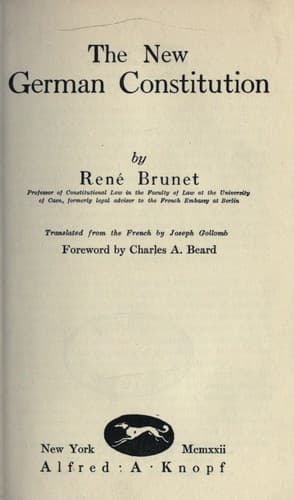
Germany -- Politics and government -- 1918-1933; Germany. Verfassung (1919)
According to the procedure of the Reichstag, no party can constitute
such a fraction if it does not have at least fifteen members. To-day
it is these groups that nominate the various committees of the Assembly
on the basis of proportional representation.[36] The group plays a rôle
in Germany much more important than, for example, in France, because of
the strict party discipline that prevails in these groups. For every new
question brought before the Reichstag each group assembles its members,
who discuss among themselves the attitude to take and the way in which
the group as a whole is to vote. When the question is most important
there are held _interfractional meetings_. At these meetings are called
together either all the members of certain groups, or only trusted men
or the chiefs of these groups. Sometimes two or more related groups
deliberate in common; sometimes they are the groups of the majority
parties. Thus, either in single groups or in common the various political
factions decide in advance their line of actions; and when the matter
comes up for deliberation in the Assembly, everything is already decided.
The public meetings of the Assembly are only a kind of show, in the
course of which a speaker for each party generally mounts the tribune to
acquaint public opinion with the motives that have determined his group
in taking such and such a stand. A certain amount of dramatic interest
is thereby lost, but perhaps the element of surprise is replaced by more
thoroughly considered and riper decision.
The vote is then proceeded to. Voting by proxy is not recognized. Only
those present can take part in the vote, which is theoretically taken
“sitting” and “rising.”
In case of doubt all the members are invited to leave the hall and then
to reenter, those voting “yes” coming in by one door, those voting “no”
by another. There can also be a vote by name, if fifty members demand
it and if the Assembly so decides. In this case ballots of different
colours are distributed among the members. These ballots bear the names
of the deputies and one of the following: “yes,” “no,” or “I abstain.” At
the moment of the vote the leaders of the various groups hold up their
ballots above their heads, this movement being immediately followed
by all the members of their groups. Then the ballots are given by
those voting to the Secretaries, who place them in the ballot boxes.
A supervision is maintained to prevent those present from voting for
absent members. This procedure presents the triple advantage of giving
to the abstaining vote its precise significance, of maintaining strict
discipline within the groups and of preventing absent members from voting.
3.--THE DURATION OF THE POWERS OF THE REICHSTAG.
The question of the term for which the members of political assemblies
should be elected is always a delicate one. It has given rise in Germany
to much lively discussion in committee as well as in plenary sessions.
Public-domain text, read in full here on John Shaqi.
Reviews
Reviews
No reviews yet
Be the first to share your thoughts on this work.
Elsewhere in the archive
Join the Discussion
Join the discussion
Sign in to leave a comment or review.
Sign InorCreate an account