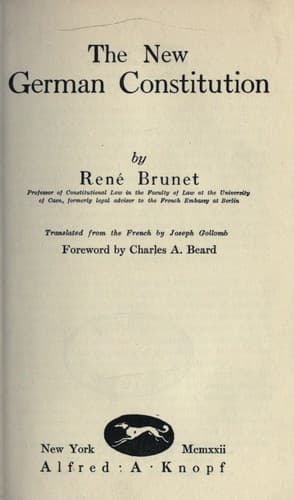
Germany -- Politics and government -- 1918-1933; Germany. Verfassung (1919)
The co-operation of the Reichsrat is manifested also in its _right of
protest_ against the laws enacted by the Reichstag. These laws must in
theory be enacted with the express or tacit approval of the Reichsrat,
but this provision is not absolute. If, in effect, after the protest
of the Reichsrat, no accord is reached between this body and the
Reichstag, it devolves upon the President of the Reich to decide whether
the project of law will be abandoned by him, or whether he will resort
to a referendum against the decision taken by the Reichsrat. If this
bill gains the support at the Reichstag of a majority of two-thirds
the President has then, in spite of the protest of the Reichsrat, the
right to promulgate and to publish the law, without any further vote
on it by the Reichstag. But he may also, instead of proceeding to this
promulgation, order a referendum, if he does not want to take upon
himself the responsibility of deciding this conflict of the Reichstag and
the Reichsrat.
There are thus two ways of breaking the opposition of the Reichsrat:
either the referendum, or else a two-thirds vote for the law on the part
of the Reichstag and joined to it the approval of the President.
On the other hand, when this majority of two-thirds cannot be assembled
in the Reichstag, there are two ways for the opposition in the Reichsrat
to become effective. First, the President may remain passive after
the protest of the Reichsrat, that is to say, he may not order the
referendum. The co-operation of the Reichsrat and of the President in
such case weighs more than the decision of the Reichstag which has not
been able to rally a majority of two-thirds in its favour. The other
way in which a protest of the Reichsrat can become effective is for the
referendum to support the objection of the Reichsrat and reject the
project voted by the Reichstag.
Public-domain text, read in full here on John Shaqi.
Reviews
Reviews
No reviews yet
Be the first to share your thoughts on this work.
Elsewhere in the archive
Join the Discussion
Join the discussion
Sign in to leave a comment or review.
Sign InorCreate an account