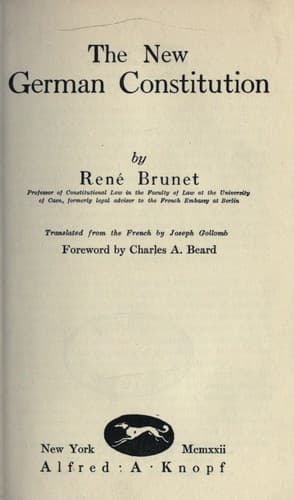
Germany -- Politics and government -- 1918-1933; Germany. Verfassung (1919)
The power of the Reichstag to legislate is, in the second place, limited
by powers assigned to the President in certain matters. He has the right
to veto any law passed by the Reichstag, in the sense that, according
to Article 73, he is not obliged to promulgate the laws voted, and may
within a month submit it to a referendum. If the President is convinced
that a bill voted by the Reichstag with the consent of the Reichsrat is
against the welfare of the people; or if there are serious objection
lodged against it of another character; or if he believes that the
law does not correspond with the conceptions held by the people, his
situation as an independent organ of popular sovereignty gives him
the right and imposes on him the duty of submitting this project to a
referendum. In addition, the Constitution (Article 72) authorizes him
to disregard a demand on the part of a third of the Reichstag that
the promulgation of a law passed by the Reichstag and approved by the
Reichsrat be deferred. He can, therefore, promulgate the law voted and
give it operative power when the Reichstag and the Reichsrat declare it
to be urgent.
In the third place the legislative power of the Reichstag is limited by
the right reserved by the people itself to decide, and in certain cases
directly on this or that project of law. Such are the cases we have
described as touching the Constitutional provisions for initiative and
referendum.
We must finally note, as the fourth legislative factor, the Economic
Council, whose powers, it is true, cannot be considered as constituting
a limitation of the Reichstag’s powers, but which may nevertheless be
called in to co-operate with the latter in the preparation of laws.
Such are the organs that participate in the legislative work. We must now
see in what manner they function and how a law is passed through this
intricate mechanism.
The _initiation_ of a law can take place under any of the following
conditions:
1. The Government of the Reich, that is to say, the Cabinet, has in the
first instance, the initiation of laws. In theory the Cabinet is supposed
to proceed with the consent of the Reichsrat; but in case this agreement
is refused, the Cabinet may nevertheless submit the bill to the Reichstag
together with a statement of its attitude. (Article 69.)
2. Members of the Reichstag may also introduce bills. (Article 68.)
3. The Reichsrat also has the right of initiation. In theory it is
supposed to act on a bill in harmony with the Cabinet. But if the latter
refuses its consent to a bill, the Reichsrat may still submit it to the
Reichstag together with a statement of its point of view on it. (Article
69.)
4. The people themselves may initiate a proposal for a law. (Article 73.)
Public-domain text, read in full here on John Shaqi.
Reviews
Reviews
No reviews yet
Be the first to share your thoughts on this work.
Elsewhere in the archive
Join the Discussion
Join the discussion
Sign in to leave a comment or review.
Sign InorCreate an account