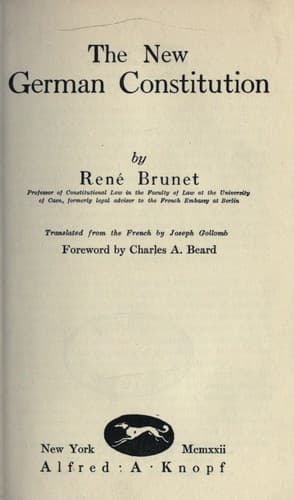
Germany -- Politics and government -- 1918-1933; Germany. Verfassung (1919)
The Constitution contains a special provision in case a constitutional
change is to be realized on the initiative of the people. In such a
case, at least one-half of the _electors_ must approve of the change.
This particular majority was introduced as a condition for the following
reason; the situation had to be met in which the Reichstag rejects a
constitutional change proposed by popular initiative. Against such a
vote on the part of the Reichstag, which may not be in favour of the
constitutional change proposed, the decision of the people in favour of
the change, to become operative must be supported by at least half of the
people. Where, however, the Reichstag votes in favour of a constitutional
change it is enough for the referendum to secure a majority of those
_voting_, provided that a majority of the electors have participated
in the vote. Consequently if the Reichstag has voted a constitutional
amendment by a vote of two-thirds and if this amendment has been
submitted by the President to a referendum, it is sufficient to nullify
the favourable vote by the Reichstag, if half of the electors of the
Reich participate in the vote and the majority of those voting pronounce
against the amendment. In other words, to effect a constitutional
amendment by means of a referendum a simple majority is sufficient if
the Reichstag has voted for such an amendment; but if the Reichstag’s
approval is to be nullified in such a case a specified majority is
required.
Another provision of the Constitution deals with the case where a
divergence of opinion arises between the Reichstag and the Reichsrat on
a constitutional matter. In general when the Reichstag, over the protest
of the Reichsrat, maintains its stand by a majority of two-thirds,
the President has the option either of promulgating the law voted by
the Reichstag over the protest of the Reichsrat, or of prescribing a
referendum. In the matter of a constitutional amendment, to strengthen
the position of the Reichsrat, the President’s choice is limited. In
such a case, if the Reichsrat demands a referendum the President cannot
promulgate the law, even though it has been passed by two-thirds of the
Reichstag. This demand must take place within two weeks of the passage
of the bill by the Reichstag. If within that time, the Reichsrat has not
made use of its right just described, the President recovers his right to
choose between promulgation and referendum.
III.--POWER OF CONTROL.
In the parliamentary system, the parliament exercises an incessant
control over the acts of the Cabinet, such control consisting of the
responsibility of the ministers. How is this organized in Germany and in
what manner is it actually exercised?
Public-domain text, read in full here on John Shaqi.
Reviews
Reviews
No reviews yet
Be the first to share your thoughts on this work.
Elsewhere in the archive
Join the Discussion
Join the discussion
Sign in to leave a comment or review.
Sign InorCreate an account