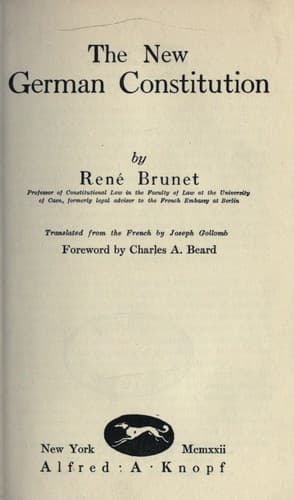
Germany -- Politics and government -- 1918-1933; Germany. Verfassung (1919)
It must be noted first that the Constitution does not give control over
the Cabinet to any but the Reichstag. It is to the Reichstag only that
the Ministers are politically responsible. The other assemblies that the
Constitution has created, in particular, the Reichsrat, have in this
respect no power. On the other hand, the confidence of the Reichstag is
absolutely indispensable to the Cabinet. If the Reichstag withdraws its
confidence in a Ministry or in a Minister, especially if the Reichstag
expresses its lack of confidence, the Ministry or the Minister must
resign. (Article 54.) To give to the vote of the National Assembly a
complete guarantee of execution the Constitution provides that the
Reichstag may prosecute the President and the Cabinet before the National
Judicial Court and demand that the people pronounce on the removal of the
President. (Article 43.)
The means by which the Reichstag exercises its control over the Cabinet
are, with some minor differences in procedure, the same in Germany as in
most parliamentary governments.
The Reichstag may, first, demand the presence of the Chancellor or the
Ministers at its meetings, whether in committee or in full session. The
Chancellor, the Ministers, and the Commissioners have the right to be
present at all the meetings of the Reichstag and its committees. The
representatives of the Cabinet have the right to be heard on their own
demand at the deliberations of the Reichstag even contrary to the order
of the day. They are subject to the disciplinary power of the President.
* * * * *
The members of the Reichstag may address _questions_ to the Cabinet. The
question must be addressed in writing, and if the author of it agrees,
the Cabinet may respond to it in writing. On the other hand, it must
not be taken up in public session of the Reichstag except on a Tuesday
or Friday at the head of the order of business. It is then read by its
author. The Minister interrogated or some one commissioned by the Cabinet
replies. But no discussion or motion whatsoever may thereupon at once
result on this reply. Only the author of the question may take the floor
after the Minister, and then only to complete or to rectify his question.
There is naturally no vote taken immediately after the question and it is
not permitted to transform a question into an interpellation, as it may
be done, for instance, in France.
The parliamentary question seems to play a much smaller rôle in Germany
than in England or even in France, if one compares the German procedure
on the written question with that of the French. During the first six
months of its existence, the National Assembly addressed about 280
questions to the Cabinet, most of them in open session. Most of the
Tuesday and Friday sessions commence with a series of questions; some of
them with as many as fifteen to twenty questions.
* * * * *
Public-domain text, read in full here on John Shaqi.
Reviews
Reviews
No reviews yet
Be the first to share your thoughts on this work.
Elsewhere in the archive
Join the Discussion
Join the discussion
Sign in to leave a comment or review.
Sign InorCreate an account